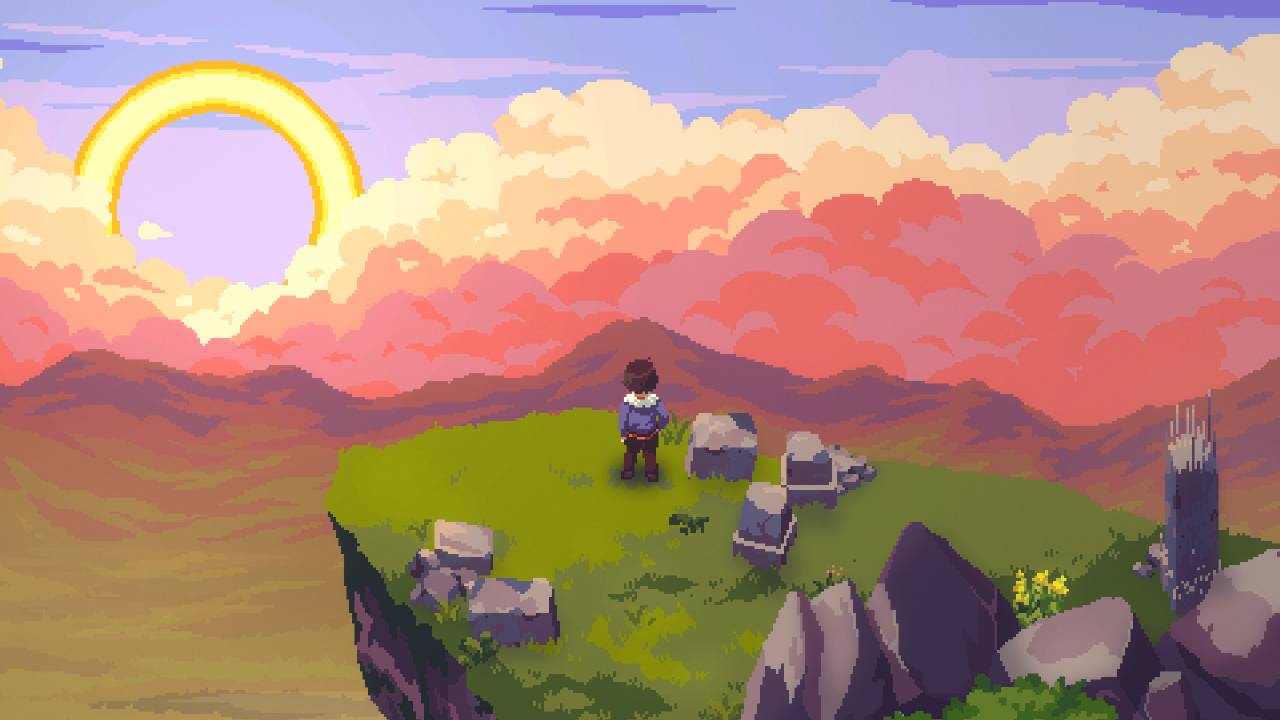
I just finished playing Nocturne, a brand new indie game from Pracy Studios that blends a pixel-art JRPG adventure with Guitar Hero-esque rhythm-based combat. I’ve been known to enjoy a rhythm game or two, so on paper, this game is right up my alley. That said, my feelings on Nocturne swing back and forth like a metronome. For everything I like about the game, there’s something else that pulls my enjoyment down. Despite this, I think Nocturne is a game that is truly innovative, especially in the rhythm game scene. I think if you are looking for a smaller game that’s trying new things, then upfront I would recommend the game, whether you are a JRPG fan or a rhythm game fan. Now, let’s get to the nitty-gritty of what this game is doing and how I feel about it.
In Nocturne, you play as Karma, a person who finds themselves waking up in a digital afterlife after they pass away. This digital afterlife, known as Maya, has seen better days. What was supposed to be a utopian afterlife where people no longer had to say goodbye to their loved ones has decayed over time thanks to a massive technical blackout, a rampant artificial intelligence, and corruption that spreads over the land. In searching for their brother Spencer, Karma meets a number of other people in Maya, like the whimsically childish Kimothy, who accompany them on their journey to not only find their brother, but also to get to the bottom of what has transpired in this digital afterlife as well as pontificating on what it means to live.
Narratively speaking, my thoughts are a bit mixed. On the one hand, I think there are some musings on the afterlife, artificial intelligence, and what it means to be alive that I found to be thought-provoking. The story subtly foreshadows themes, characters, or plot points that are eventually paid off in a satisfying way. I particularly enjoyed a line of dialogue after one of the first major bosses is defeated, a simple line saying, “She will betray you.” Even a simple line like this can stoke the mind, and I really wanted to see where the overall story was heading.
On the other hand, while the story was gripping to a certain extent, I feel there were some pacing issues, particularly towards the ending. Part of this may be caused by the design of the combat loop, but putting that aside for now, I felt like the game was taking its sweet time to come to a conclusion, without adding much intrigue along the way.
For me, the characters of Karma and Kimothy took a few hours before they really started to click and become likable, and with how much dialogue there is in general, as the game is part RPG, I would have hoped to connect with them a bit earlier on. If nothing else, the narrative in Nocturne is ambitious. It tackles a lot of big themes and asks a lot of questions, and for the most part it’s an engaging story that occasionally stumbles along the path.
The story isn’t the only ambitious aspect of Nocturne; its Guitar Hero-esque rhythm combat is equally ambitious, and is by far the best part of the package. While I am majorly simplifying things by comparing the combat to Guitar Hero, the truth of the matter is the combat in Nocturne has a lot going on under the hood to the point that this combat system plays in a unique fashion and feels truly innovative.
A talking point I see from time to time online is “how to make JRPG or turn-based combat more engaging?”. Paper Mario engages the player by including timed button presses to modify your attacks; Clair Obscur Expedition 33 folds in parrying and dodge mechanics in order to make sure the player has input even when it isn’t their turn. The approach taken in Nocturne might be one of my favorite approaches to answering this question.
In an attempt to break everything down, I’ll try to describe a basic combat encounter. Enemies patrol the world and will run towards you to engage in a battle. On the battle screen, you have four “lanes” in front of you; each lane corresponds to a specific button on your controller or keyboard.
On the topic of control schemes, it took me a while to find a button layout that worked for me. I started on a controller but couldn’t wire my brain to keep up; I then switched to a keyboard using the number keys, but I was still struggling. Ultimately (and pretty funnily, to be honest), I landed on using the “0” key from the number pad and the right, down, and left arrow keys for hitting notes, and I would hold the keyboard upside down, emulating the feel of a Guitar Hero guitar controller. Once I did this, the combat started to click for me in a big way.
Once the “song” begins, notes will fly towards you, and you will need to press the corresponding button in time with the notes passing a specific region towards the bottom of the screen. Hitting notes successfully allows your attack gauge to slowly build, and once full, you are able to unleash an attack on the enemy. Once the song ends, the enemy is defeated, and you gain XP and occasionally receive items as rewards. Simple enough?
Let’s add in some more layers. The enemy has an “Energy” gauge and an “Attack” gauge. The enemy’s attack gauge will continue to rise at a steady rate, and once full, they throw out an attack telegraphed by the note lanes glowing yellow for a brief moment. Should you attack during this wind-up period, your attack will deal a critical hit and, as a result, will deal increased damage. Deal enough damage to their energy gauge, and the enemy will become staggered, which essentially means they are unable to attack for a period of time. This is some really smart game design; enemy attacks are telegraphed in an easy-to-read fashion even when you are focusing on the volley of notes hurling your way, and it also incentivises a bit of a risk-and-reward playstyle, rewarding increased damage and enemy staggers if you time your own attacks thoughtfully.
Notes that are hit successfully are ranked in a range, from “miss” and “ok” to “great” and “perfect”. At the end of a song, you are scored based on how many notes you successfully hit and how many you miss, and are assigned a letter grade. Depending on how well you score on a given enemy, you can unlock variations on their battle theme, which will randomly cycle out each time you fight that enemy type. This allows for the repeated battles to feel a bit more fresh or unpredictable each time you engage in battle. And in true rhythm game fashion, the ultimate goal is to complete a song without missing a note. And should you complete a song with a full combo, you receive bonus XP on top of what you would normally earn.
There are many other elements that build on top of each other that make Nocturne’s combat system sing, like the introduction of consumables and equipable gear. Consumable items can be used during combat for a variety of effects like healing, modifying damage output, restoring attack gauge, and more. Gear similarly bestows a number of passive and active abilities, from giving a stacking damage buff for landing successive attacks to unleashing a riposte move that blocks and reflects incoming damage if you hit the attack button in a very small timing window. I found myself experimenting with various pieces of equipment, trying to find different synergies and playstyles that worked best. I ultimately landed on the gear I described above, buffing my damage output and reflecting incoming attacks in order to stagger enemies as fast as I could, all the while negating any and all incoming damage. I didn’t really engage with the consumables system all that much. Perhaps they would be more efficient on greater difficulties; I mostly switched between the Novice and Adept difficulties (difficulty options 2 and 3 out of 6 available to choose from) and never really felt the need to engage with the system all that much.
On the topic of difficulty, I mentioned switching between the Novice and Adept modes above, and I mainly swapped back and forth because I felt there was a bit of a mismatch present. I am fairly familiar with games like Guitar Hero and Rock Band, and as a result, the Novice difficulty felt a little on the easy side, where I could routinely score A or S ranks on most enemies. However, when I turned the difficulty one step up to adept, the difficulty felt a bit too frantic, and I could basically only score D or C ranks. Adept felt a bit more fun as a result of the increased speed and amount of notes, but Novice felt like a better pace to actually enjoy the game. It’s not necessarily an issue per se, but it did feel like there should have been a more gradual step up in difficulty, especially with there already being six different modes selectable from the start. One positive to this system, though, is that you are able to switch difficulties at any time, so finding a difficulty that suits you as you play the game is totally possible and encouraged.
One small wish I had while playing is for gear or weapons to be visibly reflected during the battles themselves. Throughout the entire game, Karma wears the same purple hoodie and uses the same brown staff in every battle, despite what gear or weapons you equip. There is a pretty humorous inclusion of a pool noodle as a weapon, and I found it a bit underwhelming that by equipping it, all that really changes is the damage you deal. Feels like a missed opportunity or perhaps something that can be added in the future.
There is more detail I could expand upon regarding the combat system, but I’ll leave that for you to discover for yourself. The final note I will add is the fun and unique ways Nocturne plays with player expectations and the 4-lane structure itself. There are moments where Karma uses their specific abilities to “cleanse corruption” in the world, and this is done by playing a small sequence of notes. However, as you play these sequences, the 4 lanes behave in erratic ways. The angles at which notes travel may veer off, the lanes may move independently of each other, affecting the timing of when to hit the individual notes. And there is one dastardly variation that moved the #4 lane into the #1 spot on the screen, so instead of hitting notes in a “1-2-3-4” order, you need to hit them in a “4-1-2-3” order. These variations were a blast to discover and really made you think and interact with the more traditional rhythm game structure in a new way, which I found endlessly impressive.
As Nocturne is part rhythm game, the music plays a pretty important part. Overall, I would describe the music in the game as inconsistent. There are some battle themes I would never tire of no matter how many times I played them, and certain themes like the battle victory theme or the theme that played in the main town were catchy and hummable, which is a sign of some good tunes. At the same time, there were a number of tracks that felt a bit generic or unmemorable. Many tracks feel like they fall into two camps: metal/rock high-energy songs, or slow epic piano songs. Songs can play around with the speed of incoming notes, and there is some variation in genre, but it felt like the game could have gone a bit further in offering up different kinds of music or sounds in an effort to have the soundtrack stick around in the mind or make more of a statement.
This back-and-forth mentality permeates into the presentation as well. Nocturne is a pixel art adventure presented in a pseudo top-down perspective. At surface level, the pixel art and sprite work are good, along with good animations. The art direction of the world of Maya has its high moments, like seeing the swirling corruption of the City of the Dead; however, like the music, I found many areas of the game to lack a bit of impact. Perhaps it’s the use of well-trodden concepts like nature-reclaimed ruins or the lackluster gray-colored memory sequences; while I don’t think there’s any aspect that appears bad or low effort, what’s there just didn’t wow me at the end of the day.
Building off of this, one aspect I felt could have used some more attention was the level design. Environments in Nocturne are often composed of multiple layers on top of each other, and due to the offset top-down camera perspective, I found it difficult to read where the path forward was. This was especially apparent in the memory sequences where chunks of the level appear in front of you and can block your forward movement, which felt clunky in its implementation. Some elements like doorways to other rooms, enemy placements and sightlines, or stairs to other elevations just felt like there wasn’t enough visual differentiation to make the main exploration feel as tight as it could otherwise. And tangentially related, some levels offer multiple paths to explore, and I found myself dotting back and forth in the same areas, unsure if the path I was taking was an optional path or the main critical path. I wanted to fully explore the environments looking for treasure chests, however on more than one occasion I progressed with the story without being able to double back and explore a side path because I chose wrong in the moment on which path to take.
Some of my criticisms may sound a bit negative; however, if there’s one takeaway I have after playing Nocturne, it’s a reminder about the inspiring talent and innovation that is born from independent game developers. I may have found some areas of the game lacking impact or disappointing in one way or another, but at the same time I found a game that took risks, that experimented, that messed with my expectations, and a game that pushed rhythm games and top-down RPGs in a new direction. And for that it deserves praise. Nocturne is available on PC via Steam. A review code was provided by the publisher.
