I had only heard of Graveyard Keeper a few years after its release. By then, it had already garnered thousands of positive ratings on Steam and had cultivated a strong fanbase for its mix of management simulation and dark humor. I never got around to playing the first game, so when the sequel got announced earlier this year, I didn’t want to miss out again. However, before we get into this review, let me set the stage. This is from the perspective of someone new to Lazy Bear’s quirky medieval world. Many of the points I make come from my initial experience with the game, and while it didn’t all work for me personally, I will do my best to stay impartial in how I present it.
It should be no surprise that the sequel to Graveyard Keeper tells the story of a graveyard keeper too. After a rushed opening that introduces the setting (a medieval town overrun by the undead), the protagonist (the aforementioned Keeper), and Larry (a talking skull), you are put in charge of burial duty at the local Inquisitor Base. Left vacant after the disappearance of the last Keeper. From there, for better or for worse, the game moves at your pace. It would be easy to glance at GK2 and think of it as a Stardew Valley-style sim. However, it differs in several notable ways that will significantly shape your time with the game.
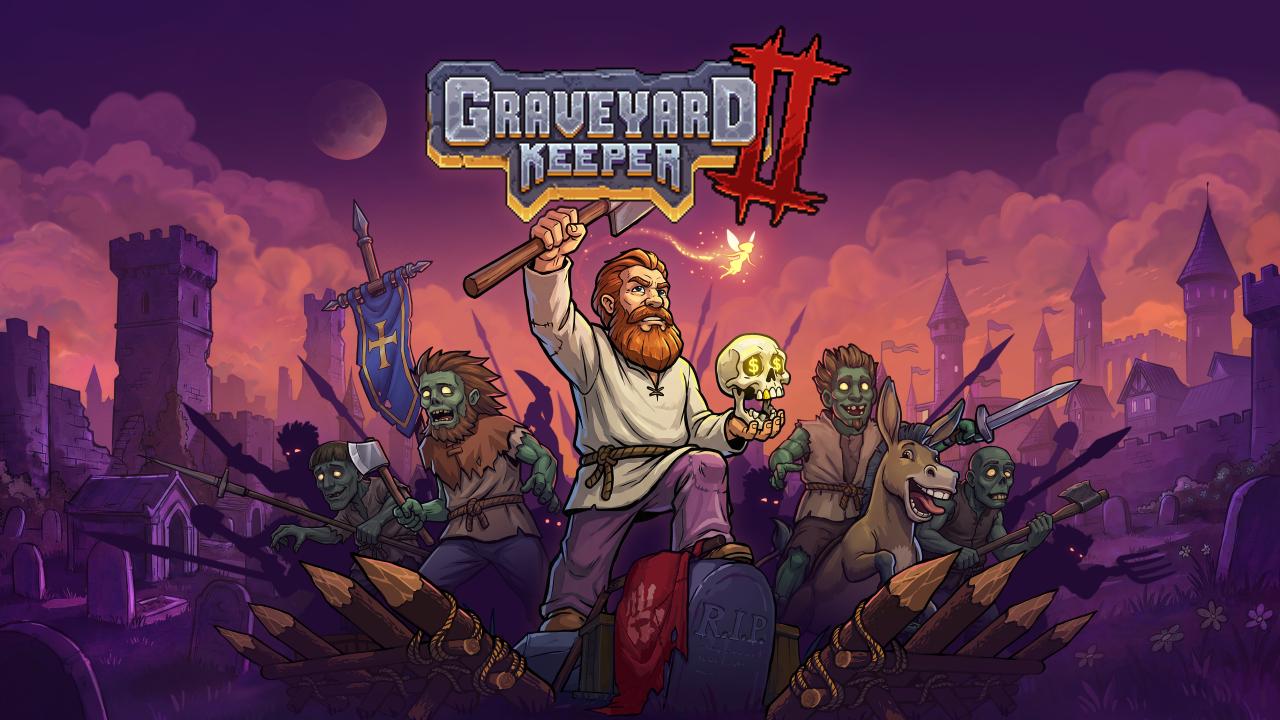
To start with a positive, one thing that impressed me right from the get-go and continued to impress me throughout my time with the game is the way it looks. Graveyard Keeper 2 looks awesome with detailed pixel art environments and immersive lighting. Time of day and weather patterns change the mood nicely and, altogether, make for a pleasant viewing experience. In the audio department, the music and sound effects are solid. The only issue I had was the narration. All the main characters are fully voiced, but they don’t sound all that convincing. In fact, for whatever reason, the Keeper often sounded like a flat text-to-speech translation. This made me switch to the mumble voice option in the settings. Similar to the first game.
Graveyard Keeper 2‘s gameplay loop begins simple enough. You are told to bury bodies the talking donkey drops off by your new home, which is a morbidly manual process that requires removing parts of the cadaver before digging a grave, burying the body, and decorating the grave. There are lore reasons for the importance of the Keeper in this world, though you find out why in a rather underwhelming way. You are given a cutscene to explain these things, but it’s narrated by the talking skull, who is recounting a conversation with the talking donkey. This particular step in the questline requires just one item, which you hand over to the skull to complete, but I really think being a part of that conversation with a drunk donkey would have made it more memorable.
Your early hours as the Keeper are spent clearing out the land to build out a workspace to your liking. Performing activities, be it chopping down a tree or digging a grave, rewards you with experience points. These are separated into three different categories (red, green, and blue) and can be spent in the Tech Tree. The sizeable tree is full of unlocks for craftable items and tools, and the choice of what to unlock next is up to you. There is also an Inspirations tab, which rewards the completion of tasks with points that can be used to unlock perks that increase character stats or abilities. These go a long way in making some of the more repetitive tasks feel a little more rewarding.
Nearly every action in Graveyard Keeper 2 drains your stamina bar. Displayed in blue next to the time of day indicator on the top left of the screen, it dictates how much work you can do in a given day. A purple sanity meter also competes for space with stamina on that same bar, increasing every time you complete the burial process for the deceased. Both of these meters can be altered with consumables. Food (like foraged berries and mushrooms) refills your energy, and drinks like beer reduce your mental strain.
Southeast of home base, there is a small settlement, stocked with a few vendors and points of interest. This is really where I began to understand that Graveyard Keeper 2 wasn’t a typical life sim. There are random NPCs wandering here and there, but you can’t talk to most of them. The characters you can chat to have some personality, often landing a few jokes; however, GK2 isn’t really a game focused on character development and making you feel like you’re part of a cozy community. Don’t expect to marry anyone here.
Instead, Graveyard Keeper 2 is more focused on the systems. As I said earlier, the game moves at your pace; however, after a few days of toil, completing some of the basic quests designed to help you progress through the Tech Tree, you have to commit to optimization or risk burning out. The game doesn’t expect you to build a factory, per se, but automation with the aid of the undead seems to be the driving design force here as you work to restore an entire town. I admit that it’s not a design that appeals to me. Though I do think it will serve the fans of the first game.
If you don’t want to fold into the capitalist machine and maximize profits through automation, like me, you can still do it all yourself. As long as you’re okay with the time commitment. Given the rather easy-going pace of the first ten hours of the game, Graveyard Keeper 2 is great for catching up on podcasts or listening to audiobooks without accidentally missing plot points. It also helps that the game has pretty simple controls. On Xbox, you move the Keeper with the analog stick, interact with objects and people with A, and work with X. Everything else, from character inventory, upgrades, unlocks, and the map, is tucked into the pause menu.
For as good as the visuals are, Graveyard Keeper 2 is a surprisingly menu-heavy game. I found myself quite often running back and forth between chests to clear my inventory. Remembering where I left something I couldn’t pick up initially became second nature after a few hours. The game has a Quests tab in the menu that helps you keep track of current objectives, but things can get pretty complicated when you start to break it down. For example, according to the Quests tab, you might need to make a clay plate. To make that clay plate, you need to use a Potter’s Wheel. That requires you to get a piece of stone that you need a wood wedge bench to craft. All that is assuming you made sure to unlock that bench in the Tech Tree first.
Eventually, I ended up taking notes on the side to keep track of what quest had what tasks. That’s not a bad thing on its own. I do enjoy any opportunity I get to whip out a notebook. My bigger point about this is that with so much going on and with so little guidance, it can be a little overwhelming for new players. (me <- new players) There are so many systems at play that it can be obtuse to come to grips with. My biggest word of caution for new Keepers is to be prepared to check the Wiki or search for some hints online until you come to grips with everything.
As is clear by now, despite not being in the target demographic, I had a decent time with Graveyard Keeper 2. There is fun to be had engaging with its build systems and exploring the quaint little town. In that way, I enjoyed pretending to be a hermit living in the woods, rather than a business-minded undertaker. However, the game’s focus on automating production and undead armies meant that it was never going to be a 100-hour game for me, personally. Graveyard Keeper 2 is out now on PlayStation 5, Xbox Series X|S, Nintendo Switch, and PC via Steam. A code was provided for review.
