Some games are trend setters. Their release is so monumental in the industry that they create a swell of inspired games in their wake. FromSoftware did this with the Dark Souls games, Supergiant Games did it with Hades, and a solo developer did it with Stardew Valley. The wider impact of these games is a topic for another day, but one downside is that smaller games can often be swept up in the sea of similar titles, making it harder than it already is to get spotted.
This makes word of mouth even more important. If you like a game, talk about it. Tell people what you like about it and why it might be special. So that’s exactly what I’m going to do for Luma Island. Of course, I don’t think it’s a game for everyone, and I won’t even begin to suggest that this is to convert longtime Stardrew fans. But for those who enjoy cozy life sims, Luma Island is definitely one to check out.
Before we get into it, let me clarify that I am reviewing vanilla Luma Island. Since its release, developer Feel Free Games has put out a big expansion to the game called Luma Island: Pirates. This adds a pirate-themed zone, new NPCs and enemies, more quests and minigames, additional difficulty options, and more. If you get Luma Island, you can enjoy the Pirates expansion for free, and it’s one that I want to revisit eventually, but, for now, I’ll talk about the base game.
Let’s start with the obvious: I really like Luma Island. It’s a vibrant life sim that’s easy to pick up and fun to play. The game starts with no real preamble. You create your character and spawn into the world beside your tiny RV. Wildlife surrounds your new home with breakable rocks and choppable trees all over the place. How you shape that land is up to you. Down a path, you find the entrance to the town. Townsfolk and tourists alike wander here and there, ready to chat and delegate quests. At the heart of it all, there’s a town hall where you can purchase a job licence. This is the backbone of Luma Island, and which one you pick dictates not only the difficulty of tasks laid out before you but also the type of activities you’ll be performing.
You can be a Treasure Hunter, going into caves and finding shiny stuff, or a Blacksmith, crafting items in your kiln. You can be a fisherman, hunting for elusive fish and helping rediscover old recipes, or you can be a Brewer like me, growing different things in your garden to make new drinkable concoctions. These professions are to give quest structure to players who need it, and they act as long-term goalposts to work toward. While I didn’t jump from one to the next like a checklist, I always felt like I was making progress. Exploring Luma Island and talking to its inhabitants will unlock more projects to complete and mysteries to solve. It’s a flexible design that makes the game as linear or open as the player wants.
Speaking of design. One interesting thing about the game is that there aren’t a lot of interiors. Other than your RV, you don’t go inside any buildings. All trades and transactions are performed from the outside. I thought this was odd at first, but I can appreciate its intent. Luma Island is a world designed around the player, not a world for the player to slot into. Of course, I can’t say if this is outright good or bad because I enjoy both. That said, with no romanceable characters in sight and most NPC questlines having to do with different professions, it’s evident that background character development isn’t the focus here.
The focus instead is on the player. You are free to roam, ignoring quests to discover hidden treasure chests, or reshaping the decent-sized plot of land outside your RV to your liking. This does bring me to one piece of criticism I have of the game, which is that the area you spawn into is the same every time. Your RV is planted on the same incline, and the same fallen logs and small boulders block your paths to other areas. This sort of takes away the magic of discovering new things every time you create a new character. However, the power to decorate the land is still in your hands. So, how you clear off the wilderness, where you build your fences, and what area you mark as your territory will still make one Luma Island feel distinct from another in the long run.
Sticking with the game’s design, there are a few key aspects that will make or break the game for some players. Luma Island is a mostly risk-free experience, and there’s not an overwhelming amount of mechanics or resources to manage either. You don’t have to monitor a stamina bar because the game doesn’t have one. You don’t have to worry about the time of day because you won’t pass out from staying up too late. Any danger you face comes in the form of spiders in the caves or violent plants in the forest. These can be disposed of with your whip, and the worst they can do is knock a few items from your inventory. On that note, you don’t even need to worry about managing your inventory because it’s infinite. You can organize your items, but if you pick up too many things, the inventory will simply expand to accommodate.
As a Brewer, this design led to a gameplay loop that evolves to be easier over the course of the game. For example, in the beginning, I had to grow the wheat or berries that were key ingredients to the drinks I had to brew. This was a fairly manual process that involved tilling the soil, planting the seed, watering it daily, and removing weeds until it was ready to be harvested. Once it was picked, I would need to get more seeds to plant, and the cycle repeats. However, eventually I came across Everseeds. These still needed to be watered and weeded, but they didn’t require replanting. Then I bought a blueprint for a water hose and, all of a sudden, watering plants was easy too. With the right tool upgrades in town, the effort it takes to do everything from breaking a rock to harvesting crops goes down. And the whole time, if ever I was confused about a crafting material or ingredient, the intuitive UI explains it all succinctly. In a neat antithesis to another recent game I reviewed, it’s as if the longer you play the game, the less friction you have with it.
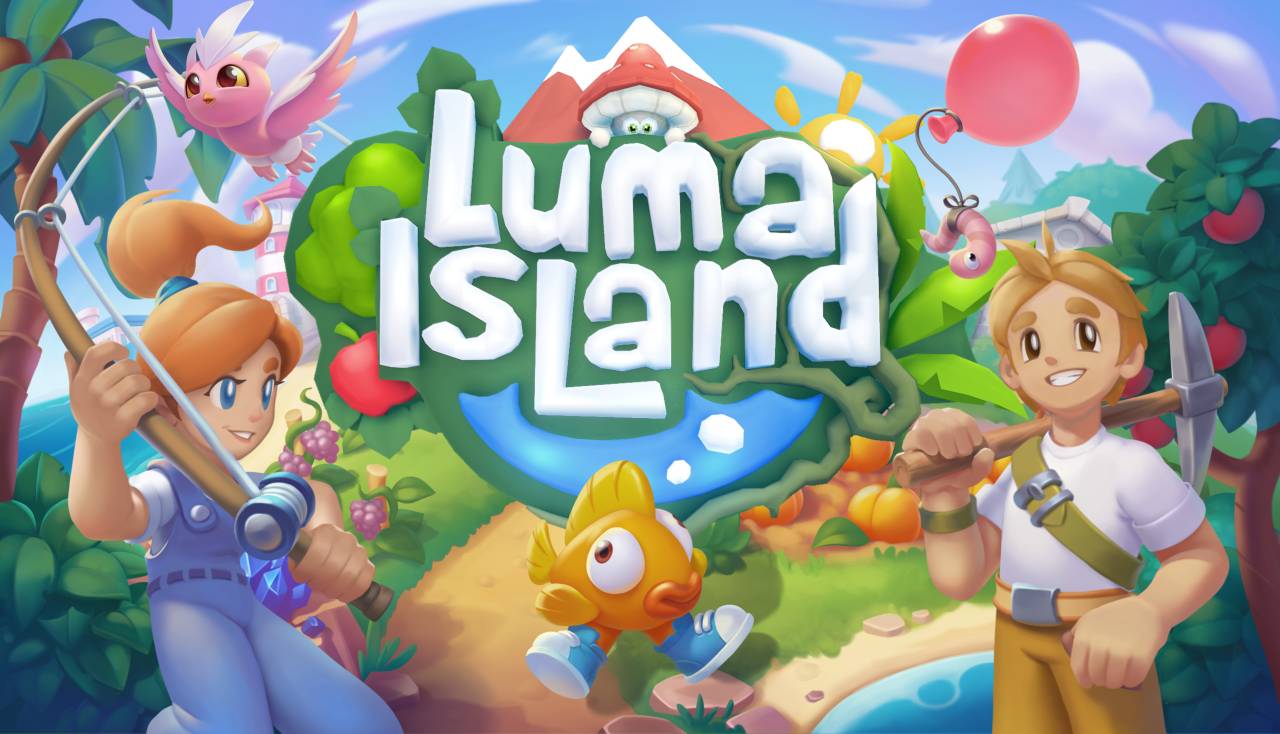
Most of your time on Luma Island will be spent exploring the beautiful locale. After all, the more resources you gather, the more prepared you’ll be for crafting items or building structures. The island is small but packed with detail, and the art style is easy on the eyes. The game heavily relies on you setting your own pace. If you feel you spent too much time farming on one day, then you can wake up the next day and set out into the forest. The map is littered with environmental puzzles that are simple but satisfying, offering a treasure chest full of goodies as a reward. One point my wife was particularly excited about is the Lumas you can hatch to join you on your adventure. These adorable little creatures will not only wander around with you as you play, but they will give you Luma Energy, an essential resource for certain tasks, and sniff out buried treasure for you to dig up.
I played Luma Island almost exclusively on the Steam Deck, and it is a perfect hardware/software combination. It’s a great game to pick up and play during a small break or while binging through Naruto, and the Steam Deck enables this with ease. After over a dozen hours with the game (most of which were with no changes to default settings), I experienced infrequent frame drops and minimal bugs. The game runs well on Deck out of the box. My only significant tweak was to bind the rear buttons to make frequent actions a bit quicker. Even if you’re playing on a desktop PC, I still recommend playing the game with a controller. I am not sure if there are plans to port this game to the Nintendo Switch, but I really hope Feel Free is considering it because I cannot think of a better home for Luma Island. Since I’ve already gushed about the visuals, I won’t say much more. The sound design fits the cozy experience, and they enhance the overall vibe of the game nicely.
Despite not having a real narrative hook, Luma Island effortlessly kept me engaged for fifteen hours. It’s a cozy life sim where you are your own boss. There are quests to complete, but you decide how you spend your time, be it running around the pretty world like a brave explorer or fishing by your RV like a lone hermit. It’s a really fun time that I can’t recommend enough for players who enjoy relaxing games without any stress. And all that’s not even mentioning the fact that I haven’t played the game with friends because co-op can only make an experience like this better. With regular updates still going out that add new features and quality of life improvements, now is a good time as any to jump in. Luma Island is available on PC via Steam, and it is Steam Deck verified. A review code was provided by the publisher.
