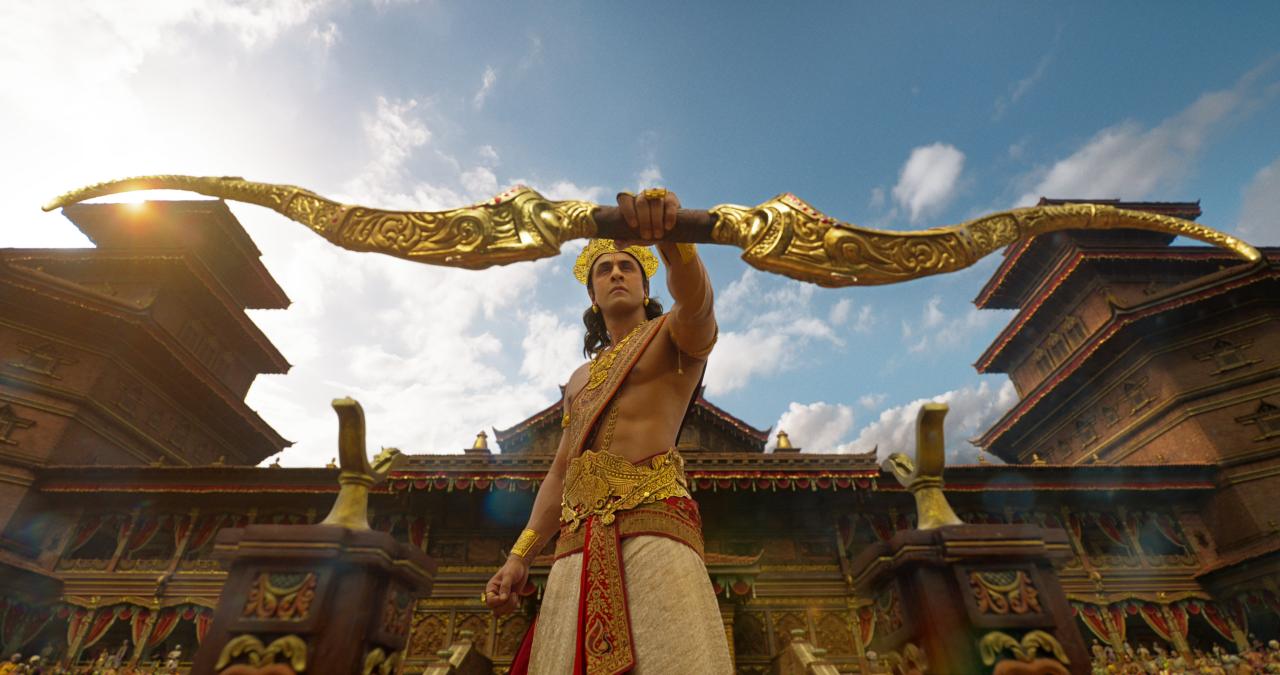
First things first, this discussion is about Ramayana: Rise of a Legend as a work of art. The film isn’t scripture, nor is Ranbir Kapoor a god. I watched the Ramayana yesterday in 3D IMAX, and I have a lot of thoughts on why this film didn’t work despite the evident ambition behind it.
Typically, I wouldn’t say it’s apt to compare 30 million dollar Indian film productions to 200 million dollar Hollywood films, but seeing as the Ramayana is reported to have a comparable budget of about $500 million for both Part 1 and Part 2, I think it’s a fair comparison.
Discussion in the comments is, obviously, encouraged whether you agree with me or not. However, be sure to read the entire article so as not to misconstrue any of my points. They have been broken into multiple subheadings for easy reading. With that said, let’s get into it.
Some Context
The Ramayana is an ancient Hindu poem written in Sanskrit. Believed to be composed around 500 BCE by Valmiki, the poem recites the story of Ram, King of Ayodhya and avatar of Lord Vishnu, as he rescues his kidnapped wife from the clutches of Ravana, the evil king of Lanka. The poem has been adapted a few times directly, but it’s a story so well-known in India that elements of it are diluted in other pop culture touchstones like Baahubali.
Ramayana: Rise of a Legend is part 1 in a 2 part movie series that hopes to bring the 24,000 verses of the poem to life on the big screen. You might notice that the name above the title is not the director, Nitesh Tiwari, but rather the producer, Namit Malhotra. He also happens to be the CEO of Double Negative (DNEG), one of the biggest VFX studios in the world, and these movies have been a long-time passion project for him.
The Story So Far
Being half of the full story, Rise of a Legend is primarily setup. The film tells the story of Ravana, a member of an oppressed clan who does a meditation so earnest that he’s granted near immortality from Lord Brahma. He uses this power to take back the kingdom that ruled over his people. This begins his reign over the kingdom of Lanka as he aims to take over the three worlds in their entirety.
Meanwhile, Lord Vishnu is reborn in the form of Ram, a prince born to the kingdom of Ayodhya. He grows up as both a smart man and a brave warrior, destined for greatness. Along the way, he slays demons, lifts a bow thought to be immovable, and marries Princess Sita. At the heart of Ramayana is the conflict between Ram and Ravana, and this first film tries to provide context for this divine intervention.
Tale of Two Cuts
One important thing to mention to anyone interested in watching the movie is that there are two cuts of Ramayana: Rise of a Legend in theaters. When the film was deemed to be a global release, it seems the script itself was reworked to work in English. While the original Hindi version, which I watched, is over three hours long, the English version is 30 minutes shorter. Notably removing some of the songs.
This is a real shame, as it assumes that the only way to make this story accessible to a global audience is to strip it of the musical quality of the source material and the Indian film industry as a whole. Which feels like an odd choice considering the fact that films like Parasite and RRR have proven that impressive filmmaking transcends cultural boundaries. We’ll talk more about this later, but suffice it to say, watch the original cut if you are interested in seeing the film.
The Good Stuff
There are certain aspects of Ramayana: Rise of a Legend that worked. Surprisingly, the Ravana storyline was the most compelling part of the movie, possibly because it’s the one that’s rarely discussed when talking about the ancient epic. Ravana and his people had to overcome a lot of oppression, and one must wonder how the devout Shiva worshiper would have turned out if guided by gentler hands.
One thing quite popularly known about Ravana is his ten heads and, to the film’s credit, its interpretation here is more practical and intriguing. Ravana isn’t shown to be a multi-headed demon lord, but rather a smart man torn between the multiple facets of himself and often succumbing to the whispers of the darkest parts.
Another thing that worked for me in short bursts was the conversations. Exchanges between Ram, Lakshman, and Sita (among others) were jovial and fun. The way Ram and Sita express their love for each other is sweet, and Lakshman’s Marvel quips provide much-needed levity. These few sequences build out the characters in much more meaningful ways than the exposition spilled at the audience for a majority of the film’s three-hour and fifteen-minute runtime.
There are some cool action sequences in Ramayana: Rise of a Legend, but the standout sequence happens at the end. The Pushpaka Vimana chase/fight is Ramayana at its best, with the best visual flair and production quality the film has to offer.
Lastly, the score from Hans Zimmer and AR Rahman is quite good, especially in certain sequences where the music alone stirs the words of the epic poem. As someone who has heard the verses growing up, it was interesting how the score brought the words back to memory during key moments of the story. With world-class talent behind it, the score remains the strongest technical aspect of the film.
Miscasts and More
To put it plainly, most of the cast in Ramayana: Rise of a Legend did not suit their roles. Instead, it feels as if they were cast for regional diversity and star power alone. Indian cinema is split up into several separate film industries, and a diverse cast with actors from different industries is believed to give the film better odds at box office success. Now, my goal here isn’t to say that someone specific would have portrayed Ram or Sita better. I simply don’t think they evoked the sensibilities their characters were supposed to embody.
This is also not to say that Ranbir Kapoor isn’t a good actor. His work in films like Barfi and Sanju speaks for itself. However, in Ramayana: Rise of a Legend, his eyes never conveyed the assured calmness expected of a character like Ram. Casting a character like this isn’t easy, and it’s something that the last major Indian adaptation of this story, Adipurush, didn’t succeed in either.
In cases like this, I believe casting an unknown actor who has the desired ease would be better than casting someone because they can put a few more people in the seats. Especially since this film was a passion project for Namit Malhotra and not just another superhero sequel that has to be made for the sake of box office relevancy.
This version of Sita, played by Sai Pallavi, is not just a damsel in distress, and while she doesn’t sell the physicality of the character when she leaps into action, she has a gentleness in her eyes that comes through effectively in the more intimate scenes.
Much like in Adipurush, the standout character of the film is Ravana. Coming off the heels of the polarizing Toxic, Yash has redeemed himself with his performance in this movie. The reason for this boils down to the fact that Ravana is a more dynamic character. While Ram is a perfect being, often praised for every “just” act, Ravana is portrayed as both flawed yet forthright, brutally taking charge and delivering on his promises when made.
The Ram Way
Right from the get-go, there’s little doubt about who is going to win any given conflict. Our hero might be surrounded by an army of bad guys, but we all know he will make it out unscathed. This removes a lot of narrative tension from the movie. Ram is such an overpowered protagonist that the best fight sequences of the movie are without him present. Ram’s greatest character trait is the thing that makes him such a difficult protagonist to connect with.
Ram simply is, was, and will be good. And he also is, was, and will be powerful. He doesn’t work to attain it either, at least not on-screen. By the time this story starts, he’s already a young man with a great physique and unmatched combat prowess. You never see him struggle to choose between right and wrong because he can do no wrong. He is a tough character to balance, and the movie seems to have no interest in exploring him any further than the surface level.
The story of Rise of a Legend is a fairly tragic one, yet there are only one or two moments where you can feel that loss. A story of a man who leaves everything behind willingly for the sake of a promise he didn’t make is inherently compelling. But other than the conversation in the Chamber of Anger and one more a little later, we don’t see these things really impact Ram until the literal last minute of the film. Ironically, for a film titled Ramayana, Ravana is given a lot more character development. Despite him being a nearly invincible person.
Grandeur Galore
Ramayana: Rise of a Legend is a film determined to convince you that it’s epic. From the grand battle sequences full of fantastical creatures to the ornate sets and costumes, the Ramayana seems sure that more detailing work and more slow motion simply means more grandeur. However, this is perhaps my biggest disappointment with the film.
Before Ramayana started, the trailer for Dune: Part Three played in IMAX. Assuming Part Three shares the $200 million budget of the second film, it’s fair to draw a comparison to the similarly budgeted Ramayana: Rise of a Legend. Story and setting aside, looking at the shot where a King stands over his people in both films, Paul in Dune and Ravana in Ramayana, shows the difference in scale and composition.
Even the big battle scenes, of which there are a few, look flat and are shot with unnecessarily wide lenses. I mean, sure the number of enemies chasing Ram and friends near the end of the movie is impressive, but the PlayStation 3-style animations detract more than they add. In fact, I would say the fight between Ravana and his sister’s husband, Vidyutjiva, had better stakes and was more interesting to watch than when Ravana punches a flying white elephant out of the sky.
Nothing is Real
This subtitle covers two different points. The first pertains to the use of AI in this film. I can’t say for certain how much of it is present in the film and how much is just rough CGI that doesn’t look the best when viewed through 3D glasses, but there were several disappointingly muddled shots in Ramayana. The filmmakers maintain that the only AI used in the film was for lip sync when dubbing the film to other languages.
The more important point here is the overuse of CGI. I understand that when you have one of the biggest VFX houses in the world under your thumb, it’s tempting to flood the movie with computer-generated imagery. However, for how much of Ramayana takes place in a forest, it’s shocking how unbelievable the forest sequences are.
I am reminded once again of RRR. It’s ridiculous to say a man can outrun a wolf or even a tiger, but seeing NTR’s Bheem running full speed through a real forest, with real lighting filtering through the leaves as a real camera rushes to capture the chase, adds believability to the scene.
In contrast, the digitally-enhanced environments of Ramayana: Rise of a Legend make it harder to believe that anything you’re watching is real. You watch a character run out of a forest to the edge of a cliff, and you wonder if any of what you’re seeing is really in-camera. This robs the film of a lot of believability in the long run.
Less is More
Of course, the root of this issue is deeper than any one person. A big-scale movie is a byproduct of dozens of departments working together to reach an ambitious North Star. I was going to continue pulling examples from Dune, but I actually think the most fitting film to mention is one that’s sharing the theaters with Ramayana.
Godzilla: Minus One came out in 2023 and became a huge hit, combining crazy monster visuals with grounded human emotions. The sequel, Godzilla: Minus Zero, released alongside Ramayana and is currently topping the box office charts.
A key reason why a Japanese film (subtitled, not dubbed) was able to bring in $58 million at the North American box office on opening weekend ($116 million globally) was that it makes you care about the people. Despite the massive monster fights, human emotions are at the heart of the film.
Even when compared to the Legendary’s Monsterverse movies, which are often packed with giant monsters, Minus Zero stands out as the exception for its restraint. The devastation of the monsters is made even more intense and harrowing because of the humans, not despite them.
In Ramayana: Rise of a Legend, more of the film is focused on delivering on-the-nose dialogues about justice in the face of darkness and slow-motion reveals that stretch on for too long, rather than developing the characters.
The Target Audience
Before I make my closing statement, I want to first pose a question. Who is Ramayana: Rise of a Legend even for? The easy answer is that it’s for Indians who grew up hearing these stories. Ramayana: Rise of a Legend is the big-screen adaptation for Indians to revisit a part of their history like never before. The other answer is the broader global audience who might have heard the name Ram but never knew the origins.
No matter which you look at it, this movie is heavily flawed. For someone like me, who has had his parents recite the story multiple times as a kid, it’s an often tiring reiteration. While the breadth of its narrative is expansive, Rise of a Legend remains a shallow exploration of a rich text. In fact, many of the themes of political intrigue and royal brotherhood were expressed better in film through Bhallaladeva and the titular character of Baahubali nearly a decade ago.
For international audiences, Ramayana: Rise of a Legend is largely inaccessible. It relies too heavily on the viewer’s understanding of each character through zeitgeist rather than on-screen character development. The film plays with some philosophical musings about destiny, which I admit stirs some thought, but most of it comes off as over-glorifying. Countless valuable minutes of runtime are spent highlighting every little thing Ram says or does. This overuse of slow motion hurts the pacing for the sake of build-up.
Closing Thoughts
All that is to say, Ramayana: Rise of a Legend is yet another adaptation of this epic poem that fails to understand why this story is special. The film spends a lot of time narrating why what you’re seeing is important or special, like it’s an audiobook, and, by the end, you find it hard to care about any of it.
There’s no better example of this than the end, when a certain character, one of Ram’s childhood best friends, is slain in battle. The sequence, while visually one of the film’s best moments, doesn’t stir any emotions because we don’t actually see their bond. Ram and this character don’t talk much, and Ram doesn’t even introduce Sita to this character after they get married.
Instead, you are to believe that because you’ve seen him twice before, they are close and that this is sad. It also doesn’t help that the character’s final words are used not to exchange something meaningful with Ram, but to tease the war that will follow in the sequel.
If some of the runtime had been used to develop characters and their relationships, I would have found myself more excited about Part 2’s release in 2028. However, as it is, the film rarely delivers a compelling reason to care other than one’s predisposition towards these legends.
If you want to watch an authentic retelling of this story, you’re better off watching Ramayana: The Legend of Prince Rama, the 1993 anime from Koichi Sasaki and Ram Mohan. It effectively tells the full story, and it’s also an hour shorter.
