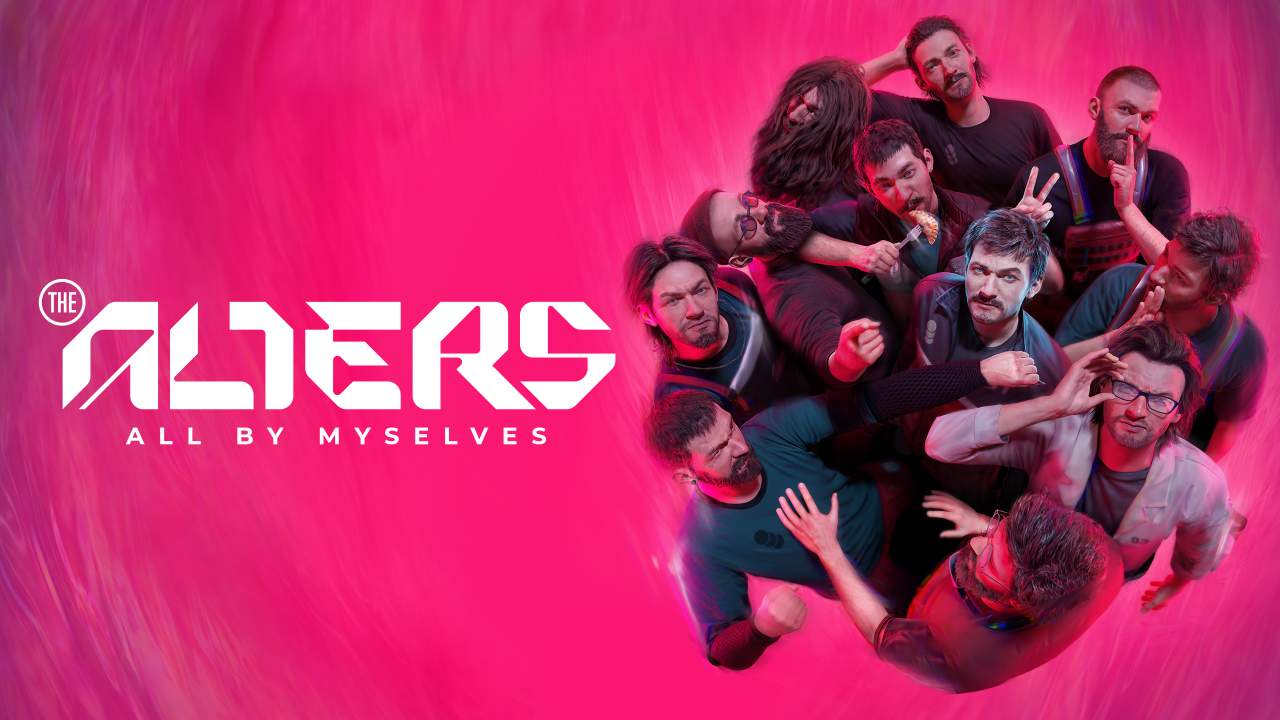
Upon starting The Alters, I had no idea what kind of experience I was in for. Coming from 11 bit Studios of This War of Mine and Frostpunk fame, I expected some tough choices and resource management gameplay. What I got was a sci-fi survival journey filled with philosophical musings, stressful situations, and a surprisingly engaging gameplay loop that blends multiple different genres into something that feels quite unique.
Let’s start at the top, in The Alters, you play as Jan Dolski, a builder who finds himself to be the sole survivor of an Allycorp mission to a hostile world in search of a rare material known as Rapidium. Upon discovering his crewmates have died while entering the planet’s atmosphere, Jan makes his way to a mobile base in the shape of a giant wheel to escape an approaching radiation storm. Once machines inside the base begin to fail, Jan quickly realizes he is entirely out of his depth, and his prospects of survival seem dim.
Jan then makes contact with Lucas, an Allycorp employee who explains just how dire the situation is. The planet Jan finds himself on is located in a three-star system, and as fate would have it, one of those three stars is going to scorch the planet’s surface with radiation in mere days. Jan will need to move the base to a different part of the planet so that a rescue party can land and retrieve him and any Rapidium that he collects for corporate interests.
Jan can’t move the base on his own, let alone gather resources necessary for survival, heal any injuries he may receive, fix broken machinery, cook food, etc. He needs a crew. But everyone died. And thus, through the use of an onboard quantum computer and a machine called ‘The Womb’, Jan discovers that he is able to use Rapidium to effectively clone himself. Although these aren’t your standard clones. These clones, or alters, are born from moments in time where Jan made a life-altering choice, and these choices led him down vastly different lifepaths with unique experiences, skills, and relationships.
While Jan’s alters are different versions of the same core person, they have vastly different outlooks on life, emotional states, priorities, desires, relationships with members of their family, and so forth. All of these factors lay the groundwork for a narrative that is multilayered and dynamic. There are moments of drama when trying to convince a particular alter to go through with a task they don’t agree with, moments of tension when choosing what information to let the corporation know about when they are in charge of your rescue, moments of joy when bonding over your shared memories of forming a band, and moments of sadness when confronting loss in your past. I don’t want to spoil too much about where the story goes, but all you need to know is that the narrative felt gripping from start to finish, from the way it handles philosophical science fiction mysteries, to the drama that arises among the crew, and to the impact that the gameplay and player choices affect how the story plays out. Based on which alters the player chooses to create and which choices they make, can have a significant impact on how certain events (including the ending) play out. ]
The story is certainly a core pillar of The Alters, but the gameplay is equally varied and interesting to discuss. Gameplay is segmented into 3 distinct modes, each with a different focus. Narrative, Exploration, and Survival / Base Management. Each of these modes has numerous systems in place that support these focuses and feed into and support each other in interesting ways.
Let’s start with the Narrative focus, seeing as we just touched on the story. Narrative threads in The Alters are primarily delivered through conversations you have with not only your alters but also people from the corporation that are handling different aspects of your rescue mission. While talking with characters, you are often presented with dialogue options that allow you to explore different perspectives, gain new information about your situation, or just to hear a light-hearted anecdote about Jan’s past. Talking with your alters can affect their mood as well as their overall relationship with you. Some alters are a bit more temperamental than others, and as such, you really need to consider how best to approach speaking to someone, being careful not to anger people to the point of them tossing their hands up and rebelling against you. As your relationships improve, you will sometimes learn “lessons” from your alters like “learning to chill out and find time to relax” or “being more assertive and learning when to say no”, and these lessons materialize in conversations as unique dialogue options that can reveal new solutions to problems or highlight new perspectives on a specific issue.
Due to its survival nature and the game only saving at the start of each day, you may find yourself reloading a save now and then. One nice quality of life feature in regards to the dialogue system is that if you reload a save, the game recognizes this and will highlight dialogue options that you haven’t selected previously, allowing for a clear way to see which options will reveal new dialogue and conversation paths. This is an awesome inclusion that more dialogue-heavy games should look to implement in the future.
The other way the story is delivered to the player is through the quantum computer. This device in the mobile base stores “mind records”, essentially a linear timeline of major events in a person’s life. By using the quantum computer, Jan is able to read through many major moments of his life leading up to going on this mission. This not only fills the player in on Jan’s backstory in a succinct manner, but also locates at various points where Jan made a life-altering decision in his past are “branching points”, moments where a different choice could have been made. These branching points predict an alternate path of where Jan’s life could have gone, what skills he would have developed, and so forth. In gameplay terms, a branching point shows which alter you will get on a surface level, such as creating a chef alter that cooks meals in the kitchen module more efficiently. It won’t share information about their temperament or emotional state, or personality, but once you select a branching point to create an alter, you are able to then read about how this new Jan’s life differed from his own. These alternate universe stories send Jan in wildly different directions and fundamentally change his relationships with people in his life, such as his parents and former wife. These different life paths were always fascinating to read through and witness how one decision could change a person’s life in such dramatically different ways.
But I think we have spoken enough about story and dialogue systems; this is a video game after all. The next focus of the gameplay is on exploration. During the day, you are able to leave the base and explore the planet’s surface. You control Jan in 3rd-person, you can walk or sprint, but surprisingly, you are not able to jump, at least not in the traditional sense. Jan’s space suit has an energy meter, and you can spend energy in order to use a climbing rope to scale tall cliff faces, or you can spend energy using a device called The Luminator, more on that later. Jan needs to explore the planet’s surface in order to collect resources to aid in constructing important mission-critical equipment and upgrades to the base, as well as assess roadblocks and gravitational anomalies that halt the team’s progress in getting to safety.
The planet’s surface is made of large interconnected hub areas. In one of these hub areas, you may be presented with three different paths you can explore. One path might lead to a patch of exposed metals you can extract, another may lead to a dead end blocked by a rock wall, while the third leads to a dark cave. As you explore deeper, you discover that paths often will lead to new resources as well as circle back around to previously explored areas. Obstacles like the rock wall can be opened up with special mining equipment, creating easily accessible shortcuts through the environment.
Each of the hub areas has a distinct visual style, from dark rocky hills glowing from a hidden lava river to a deep network of caverns snaking through the walls of a ravine blasted by sandstorms. Visually speaking, the environments steal the show at many points in the game. But outside of the visuals, the way in which the environments are designed feels a bit maze-like at the start and as a result can feel a bit daunting to attempt to tackle. But as you spend time exploring the nooks and crannies and opening up shortcuts, you begin to discover optimal routes to get to where you need to go as quickly as possible, which feels incredibly satisfying.
A big driving force behind the exploration is discovering and collecting resources. Most tasks you are set in the game will be achievable through the use of resources, from building equipment and upgrades, to creating alters and fueling the base for the journey that lies ahead. There are a few different categories of resources you can find on the planet’s surface: metals, organics, minerals, enriched metals, and Rapidium. These resources are used for a variety of applications. Metals, organics, and minerals are used in various combinations to create new modules for the base as well as for crafting useful equipment like drill charges to blast away rocks or suit batteries to recharge your suit’s energy out in the field. Enriched metals can be broken down into both metals and organics through the use of a refinery module, although, while it’s more efficient than mining both metals and organics on their own, enriched metals can only be mined in radioactive areas, which puts you and your alters at risk of injury while extracting them. Rapidium is used for creating new alters along with building mission-specific equipment, and lest we forget that the corporation is looking to grab as much of this material as it can as a bit of a reward for saving your skin.
I appreciate how The Alters streamlines its approach to resources. There isn’t an extensive list of items to craft or multiple different versions of a type of metal or organic that serve specific purposes. By simplifying the resources into broad categories, it serves to not overwhelm the player in the tiny minutiae, seeing as they will already be overwhelmed by all the other problems that arise in attempting to manage a group of people trying to accomplish a difficult mission and all the unforeseen problems that come along with that.
While exploring, you may stumble across a crashed space pod. These pods contain Jan’s personal belongings that he brought with him on the mission. These are items that have positive memories attached to them, and these items can be given to your alters to increase their mood as well as shed some light on a particular moment from the past. You can also find movies that can be brought back to home base and can be watched in the evening. These movies consist of a series of live-action skits from a group called Chris and Jack. While these comedic shorts aren’t anything to write home about, they do bring a little bit of levity and fun to the day-to-day tasks which involve hard manual labor or intense negotiation among the alters.
Resources and scattered belongings aren’t the only things you will come across while exploring. Jan discovers these strange gravitational anomalies on the planet’s surface, and these anomalies are essentially the game’s “enemies”. These anomalies distort light and gravity around them, appearing as amorphous blobs floating in the air. They come in different forms. One stays in a single position, unmoving, while another follows you if you get too near; one even sends out an expanding and contracting wave of radiation that damages you if you touch the distortion. Each of these anomalies has a single or multiple cores that can be destroyed by using The Luminator, a specially designed flashlight-esque device. Once the cores are destroyed, the anomaly disappears. This is essentially how combat works. It’s untraditional in its approach, but based on the tool/weapon being a flashlight, it actually reminded me of how combat works in the Alan Wake games, just without using firearms to dispatch your foes after blasting them with light. These anomalies drop a material known as Alx, which can be researched and refined into other resources like metals or organics.
While it takes a bit of time to understand how this “combat” loop works and what to look out for when moving through more dangerous areas, once I got the hang of it, I found the little bits of action to be a welcome wrinkle in the exploration loop. There is a certain degree of mystery that comes with discovering a new anomaly for the first time that pushes you to observe them closely, learning how they operate and how to take them out. As the game progresses, the combinations of anomalies present tricky combat puzzles to try and overcome, which can add a layer of tension when you are trying to run back to base before a radiation storm arrives, only to be caught in a web of nearly invisible enemies building up your radiation meter before the storm even starts. While it’s not the most intricate or deep combat system, it feels grounded in the world in a way that feels immersive.
The last focus of the gameplay comes in with the management aspect of the game, both in managing the mobile base as well as survival elements. At the end of the day, it’s through proper management of your resources that your base operates at peak efficiency and enables you to continue on your trek towards rescue.
As I mentioned at the beginning, the mobile base that serves as your home on this planet is in the shape of a giant wheel. This giant wheel design not only has the cool sci-fi ship look, but also serves a gameplay purpose as you can almost always see where home is from a distance while you are out exploring on the surface. Inside this wheel are a number of modules that contain various rooms such as a kitchen for cooking meals, a workshop for building equipment, a laboratory for researching new equipment and upgrades, and so forth.
You create new modules with resources and place them in a grid formation. The modules can be moved and re-oriented at any time, which is handy when you have to change your entire configuration in order to make room for a larger module; the only restriction is that the modules need to physically connect to each other before you can exit the build menu. The size of the grid can be expanded throughout the game, giving you a larger play space to build within. However, as the base grows, so too do the requirements for storing resources, as well as the amount of fuel the base requires before being able to proceed on its voyage. Modules can also be prone to failure, an issue that can be exacerbated during a magnetic storm, and require maintenance time and repair kits in order to go back to full working order.
Depending on the type of module, it may require someone to be present in order to function. This is where managing your alters comes into play, seeing as Jan can’t be everywhere at once…Or can he? You can assign your various alters to modules or tasks where their skills will prove beneficial. For instance, the laboratory needs to have a scientist alter assigned to it in order for research on upgrades and equipment to be conducted. Certain tasks like building in the workshop can be done by any alter, but depending on their skillsets, some alters may be more efficient at building than others. So you need to be mindful about who you are assigning where each day to make sure you are maximizing your output each day and making progress towards accomplishing your goals. Another nice quality of life addition is when an alter finishes an assigned task and there is still time left in the day, they will reach out and ask if they should be moved to another task or location, and with the push of a single button you can automatically assign them without having to navigate through numerous menus to achieve the same result.
While sending your alters off to do your bidding and work themselves to the bone may sound nice, it does take a toll on them. Alters can injure themselves if they are inexperienced in operating a specific piece of equipment, they can get radiation poisoning from being exposed to the environment or if the base’s radiation filters run out, they can even get burned out and reduce their work hours if there isn’t special attention given to allowing them to properly unwind and relax in the evening. You may find yourself in a situation where you really need to get a lot of manufacturing work finished, but if you don’t take some time to watch a movie with everyone and decompress, it can end up taking twice as long to finish your project due to the repercussions of a crew experiencing burnout.
On the topic of the needs and desires of your alters, people need to eat. So, on top of balancing the alters’ emotional states, fixing issues that arise from both internal politics and external natural forces, gathering resources for upgrades, talking to shady corporate folks asking you to do more for them, you also need to make sure everyone is fed. That means building a greenhouse, having someone grow food that can then be sent to the kitchen for someone else to cook. Better food will improve everyone’s mood, but a crummy-looking mush costs less to produce and finishes in less time, freeing those people for other tasks.
I’ve sort of danced around this point for most of the review, but the single most important resource you have to manage in The Alters is time. Time is the ultimate adversary; it is the ticking time bomb of a star approaching to cook everyone alive, and it’s the one element that puts pressure on you, the player, forcing you to constantly make tough decisions about what to prioritize and when. Figuring out a solution to crossing a lava river takes time, researching and producing the required building materials takes time, not to mention balancing all the other aspects of the game I’ve already mentioned.
Time manifests itself as a gameplay mechanic as well. At the start of each day, you are reminded of the star’s current position, whether it’s far away or on its approach. Each day is regulated by a timer that is constantly ticking down. Tasks I’ve mentioned above, like cooking food or extracting metals, take time to complete. The majority of your day can be spent doing work tasks, but as night draws near, radiation storms will brew that push you to return to base. In the evening, you can continue to work, albeit at a slower rate as you are now tired, or choose to socialize with the alters. There is yet another portion of the evening where you become exhausted, and any time spent doing tasks while exhausted will push your start time later into the following day, eating into the time you can use to complete future tasks.
There is also a unique anomaly known as “time dilation”. This anomaly is a localized field where, upon entering, Jan’s movement is physically slowed to a crawl, but the time on the daily timer begins to accelerate, pushing you to find the core of the anomaly and take it out as quickly as you can. This was an incredibly inventive way to demonstrate this scientific phenomenon in the form of game mechanics that I haven’t seen in any other game ever.
If what I just described sounded like a lot to keep track of and handle, it’s because it is. The one word that kept coming to mind as I played The Alters was stressful. There are constant tasks requiring your immediate attention while reminders about how dire your situation is push you to act quickly. There are countless unforeseen problems that arise through natural gameplay or through the narrative that require you to split your attention even further, which continues to add to the stress of trying to complete everything you need in order to progress. Initially, I didn’t love how stressed the game was making me feel; it felt insurmountable at times early on, where I completely botched my first crack at Act I and had to reload an old save to try again. But as I stuck with the game, the time crunch and the stress it caused really started to feel like the glue that held the entire thing together. Without the time pressure pushing you to make decisions, the stakes and danger of the situation would feel absent. Sure, you can still reload saves, but seeing as the game only saves at the start of a day, you are voluntarily setting yourself back by choosing to do so. I’m sure elements of the story would still hit hard without a time pressure present, but the overall experience from the narrative to the moment-to-moment gameplay is molded by the limited time you have. While it gives the game a palpable sense of challenge, it also narratively touches on the theme of how you spend the time you have in life, is it spent buried in your work or connecting with a loved one? So I really came around to appreciating the role of time in The Alters.
I should say, while I came to appreciate the struggle with time, I don’t think it is a structure that will be enjoyed by everyone. If you are the type of player who doesn’t enjoy being given a deadline to complete something in a game, then this is a pretty extreme example of that, and you likely won’t enjoy The Alters at a structural level. Narratively speaking, the game puts forth many philosophical quandaries and asks a lot of questions about the ethics and legality of cloning, what constitutes life, manipulation, and many other heady sci-fi concepts. The story and the gameplay ask a lot of the player, and I think that could rub some people the wrong way. But if you open yourself up to the game and are in the mood for a thought-provoking game that is trying to create a very unique blend of genres and styles, then I think you will really dig what 11 bit Studios has cooked up.
As this review winds down, I wanted to take some time to comment on the presentation and technical aspects of the game. I briefly mentioned it above, but visually speaking, the game looks great. Everything from the environments to the look of the modules in the base, to the otherworldly rock formations has a grounded yet fantastical sci-fi look. Lighting is impressive throughout, which contributes heavily to the mood of each area in the game. And the various different character models for Jan and the alters look highly detailed and distinct.
This is an ambitious game, but one area that suffers a bit is the character animations. Walking and running in-game look a little floaty and goofy at times, lip syncing is a little spotty in that it doesn’t look fully synced up properly, and the alters will cycle through very recognizable and similar animations when expressing different emotions. While they are technically the same person, seeing as the personas are so vastly different, it stands out as looking a bit odd, especially when compared to how grounded and immersive the other aspects of the presentation are.
Sound design in The Alters receives top marks. The music in the game feels fairly background at times, but the sound effects themselves are crisp and serve both a mechanical purpose as well as heightening the immersion. The way you feel the wind and dust blow into the base during a storm, to the alert beeping on your HUD to notify you that a module has failed, to the bass-filled satisfaction of zapping of The Luminator when defeating an anomaly, all through the sound design is impeccable.
Lastly, technical performance and bugs. I played The Alters on PlayStation 5 and opted to play in performance mode. While the framerate is noticeably smoother in performance mode when compared to fidelity mode, the game still dipped in moments where a lot of on-screen visual effects or fast movement were occurring. The game would also hitch briefly when performing fast menu navigation. There were some visual artifacts I noticed again when moving quickly like a sort of shimmering halo of light around Jan, and there were occasionally moments when navigating the environment where I would get stuck on a stubborn piece of rock and would have to back up and run at a different angle seeing as there is no traditional jump button to barrel over it. Ultimately, these bugs weren’t frequent enough to have a negative impact on my playthrough, but they occurred with enough regularity that they were certainly noticeable throughout the 28-hour playtime.
As I said at the beginning of this review, The Alters surprised me. It is a game that I would consider to be out of my direct wheelhouse or preferred genre, but from the gripping narrative, smart game design philosophies, and engaging exploration, I found myself really enjoying my time with the game in the end. It is not a game that will appeal to everyone, but for those who give it the time and approach it with an open mind, they will be met with a unique experience that is as ambitious as it is fun. The Alters is available on PlayStation 5, Xbox Series X|S, and PC. A review code was provided by the publisher.
