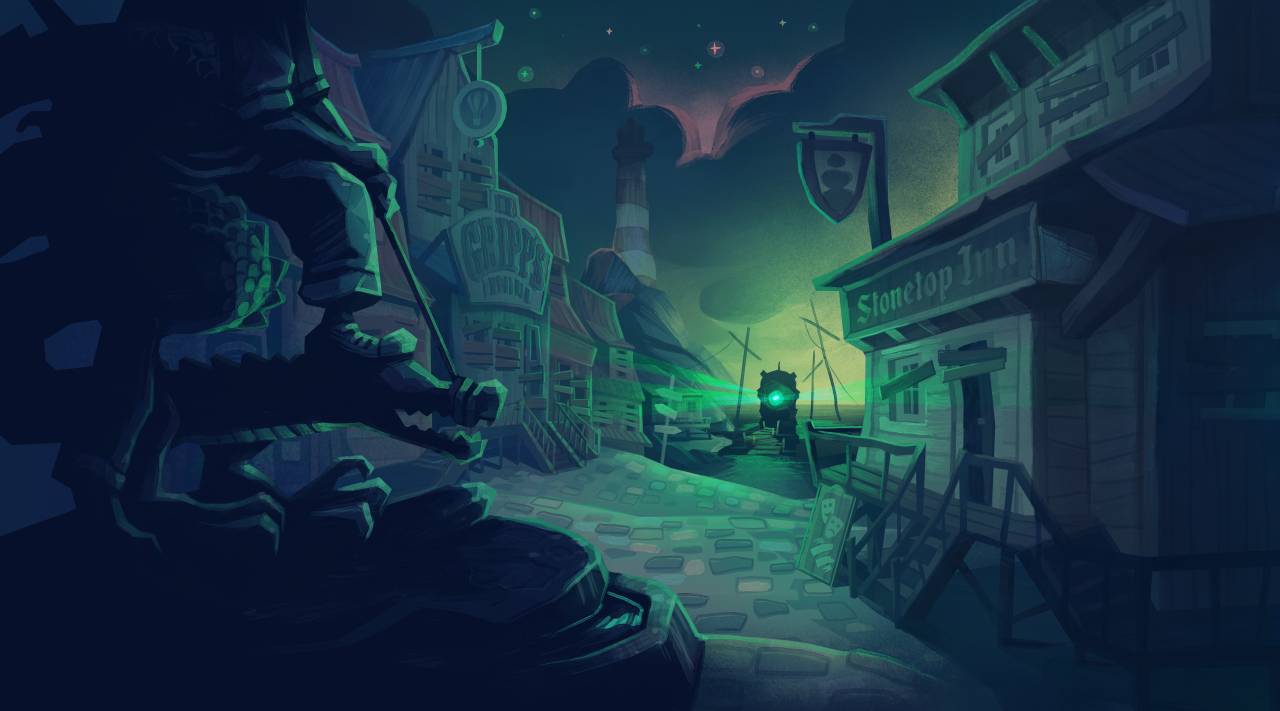
SFB Games, the developers of Snipperclips and Tangle Tower, recently announced that The Mermaid Mask, a follow-up to the team’s detective mystery, is coming soon. After a pause in development following the success of Crow Country in 2024, SFB is back to work on the Detective Grimoire series, which began as a flash game on Newgrounds in 2007.
We got the chance to ask Adam Vian, Creative Director at SFB Games, a few questions about making a direct sequel with The Mermaid Mask, the impact of Crow Country‘s success, how the industry has changed over the last two decades, and more. Here’s what they had to say!
First off, congratulations on the success of Crow Country. How has the success of that game impacted SFB and the production of The Mermaid Mask?
Vian: Thank you! The downside of Crow Country‘s success was that it took our attention away from The Mermaid Mask a little more than we’d planned, and for a little longer. But the upside is that it’s sold well, so it’s given us a little more runway while we turn back to Detective Grimoire and think about other projects, which, of course, is the hope with any game we release.
I also learned some new skills during Crow Country – 3D modelling, for instance, which I’ve put to use in various small ways within The Mermaid Mask. To be clear, I should say I didn’t model the beautiful 3D clues; they were modelled by our 3D artist, Kindra Dantone, and the 3D objects that feature in a few of the puzzles were modelled by our puzzle artist Kitt Byrne.
The Detective Grimoire seems to be the only time SFB is doing a direct sequel. What draws you back to this series, and what are some of the most exciting and terrifying parts of doing so?
Vian: It’s true, this is the first time we’ve made a Detective Grimoire game where we didn’t start from scratch with a new art style. With every previous entry, lead artist Catherine Unger and I would always feel like our art had developed enough where we’d want to throw old the old stuff and make a big leap forward, but that rate of improvement (mercifully) levels off as you get older. I still think Tangle Tower looks great, basically. So yes, The Mermaid Mask is a direct sequel in a way the previous games weren’t. That said, we’re always careful to position it as something new players can happily jump in on. You don’t need to play Tangle Tower beforehand! (You could…! But you don’t have to.)
In general, the Detective Grimoire games are a place where Catherine and I can indulge in our enduring love of pulp adventure and slightly supernatural mystery, which is a space I’d happily visit over and over again – for example, I’ll never get bored of Indiana Jones or Tintin, I could enjoy them just the same, decade after decade.
As games, they’re fun to develop because you get to come up with so many ideas, in the course of inventing so many characters, locations and objects. If you love coming up with ideas and designing stuff, as we do, they’re the perfect kind of game to make. The terrifying part is mostly how much work they take, from the earliest days of pre-production idea generation all the way through the post-production cleanup. The Mermaid Mask was more work than Snipperclips, it was more work than Crow Country, and yes, and it was more work than Tangle Tower. Much more. Oops.
In our last interview, we touched on the idea of live streaming’s influence in horror game adoption. Does this still apply to a detective game? Is it seen as primarily a game to be played alone, or is there some worth in the idea of a group discovery experience?
Vian: Officially, The Mermaid Mask is a single-player game, designed to be played by one person. However, there is a significant co-operative experience to be had if you’re so inclined; lots of people have told me how they played through Tangle Tower with a friend or loved one – sharing theories out loud, openly speculating about what’s going on, tutting and grumbling about characters they’re suspicious of, and so on. It can be a lot of fun!
So yeah, in that regard, it’s a great fit for a streamer with an audience. The problem comes if anyone in the chat has already played the game and has the power to spoil things, which is easily done, even if you’re attempting not to.
Another former question was about Snipperclips being a vibrant outlier game, and you mentioned wanting to make more vibrant games. It seems as though The Mermaid Mask and previous games in the Detective Grimoire series fulfill that desire. Which genre, in your experience, is the most fun to design from a visual art perspective?
Vian: Mystery detective games like The Mermaid Mask, games that have a coherent world, lore, backstories, and so on – they’re more engaging to design because the end result holds that much more meaning. People don’t go on Reddit to speculate about the secret implied meaning of Level 2 of World 3 in Snipperclips; you just play it, it looks nice, it makes you smile, it serves its purpose, and then you mostly stop thinking about it. The Mermaid Mask is about worldbuilding, it’s about storytelling, it’s about characters and real human themes – so you put a lot more of yourself into it, and hopefully, it lingers in other people’s minds a lot longer.
The Mermaid Mask also has a lot of variety in terms of colour temperature and tone. For instance, some of the clues you’ll find are gloomy, mysterious, ancient antiques, and some are inane, colourful modern objects like a movie magazine or an action figure. We do both! In fact, the juxtaposition of those kinds of things next to each other is where some of the game’s unique energy comes from.
Detective games feel like they ride a very fine line of being overly simple or overly complex. How do you find where to tow that line in this game/series?
Vian: Historically, I’d say we have been designing the Detective Grimoire games with a certain ‘casual’ audience in mind, particularly because we used to focus on mobile platforms. I often think about all the people who played Professor Layton on DS when it was a big mainstream hit – lots of ‘non-gamers’ found Layton to be palatable enough to give it a go and fall in love with it, but where are they now? Did they go on to play more adventure games, or did they perhaps find them too complex and intimidating and drift away from the genre? It seems like Tangle Tower fit quite well into this niche, as I’ve had many people say to me, for example, ‘My mum never really plays games, but she played Tangle Tower, and she loved it!’ – and that’s great, it makes me happy.
Now, that’s all well and good, but we may have screwed this up, because I do think The Mermaid Mask is heavier and more complex than Tangle Tower. It certainly asks a little more of the player. Sure, for some people, that’ll be a good thing. But maybe some of those people who could only just manage Tangle Tower will be scared off by Mermaid Mask. I don’t know. At this point, we’re just making the game we want to make, and wherever it ends up falling on the simple/complex spectrum is fine with me.
When designing a detective game that uses static backgrounds, how difficult is it to make important information stand out to the player? Or is it more a matter of making as many background elements in the backgrounds as interactive as possible?
Vian: We try to have a rule about how we don’t like to devalue things by defining a hard line between ‘important stuff you need to click on’ and ‘stuff you can ignore’. In theory, every single thing on screen has been intentionally added to the game for a reason, and it holds some kind of meaning, however small. So clicking on anything and getting the examine dialogue will never be a waste of time.
That said… there are, of course, important things you need to click on. Making sure the player notices the clues and puzzles they need to progress is mostly achieved through layout, colours, and detail hierarchy, and it’s something Catherine is pretty practiced at, at this point. We also have a soft hint system on the map that (if you ask for it) will give you a nudge to return to a room if there’s still a clue waiting to be discovered there – but it doesn’t tell you what to do, it won’t say any more than ‘Let’s explore the Control Room’ or whatever.
While playing the demo for The Mermaid Mask, I enjoyed the deduction mini-game that allows you to piece together an observation based on clues you have previously gathered. We imagine a system like that probably gets pretty complex as the game progresses. How do you ensure that the list of parameters remains in check so as not to overwhelm the player with a list of options?
Vian: Well, the amount of options is always the same – for that kind of puzzle (internally we call it the ‘Mind Game’) there are always eight subject components, and two sets of five connector components. You can normally get started heading in the right direction just by picking a couple of components that you know you’re supposed to be talking about, and then the correct sentence might soon become apparent, even if you didn’t have it in your head when you entered the screen. We like to think that these ‘Mind Games’ are a great way to give players the agency of laying out a conclusion themselves, but conversely, they’re also a good way to ‘funnel’ a player towards that conclusion if they haven’t actually come up with it yet. The fact that they seem to perform this double duty rather well is the reason they’ve become mainstay of the Grimoire games.
SFB is nearing its 25th year, and a lot has changed both in terms of the gaming industry and Super Flash Bros. What’s your perspective on these changes in the last quarter of a century?
Vian: A lot of games now are too big and flashy, and they take too long and cost too much money to make. Franchises on PlayStation 1 used to sometimes get one game every single year – there were five Tomb Raider games in the space of five years. Now, a single game in that same franchise might take five years to make – or more! In my opinion, even the big companies should go back to making smaller games with worse graphics. I’m not saying don’t make massive AAA games, I’m just saying don’t balance your entire company on it. Sorry, was I supposed to be talking about SFB? Obviously, the world of indie gaming has long been an effective balm against the bloat of AAA nonsense, and I’d like to think we’ve played our little part in that. Things keep changing, though, even in the last few years, it seems like every year, Steam is yet more important to indie developers, while over on mobile, the incentive to release premium games on mobile app stores feels like it’s at an all-time low.
Going off of that, does anything stand out as exceptional or surprising looking back from TentaDrill to The Mermaid Mask?
Vian: Huh. I wasn’t aware anyone had played TentaDrill.
That’s it for the interview. Thanks again to Adam for the answers. The Mermaid Mask is expected to release this Summer on PC via Steam. You can go play the demo for The Mermaid Mask now as part of Steam Next Fest. As always, don’t forget to wishlist the game if you like it, as it helps the team a lot. Be sure to check out our conversation with Adam Vian about Crow Country from 2024, and click here to play TentaDrill on NewGrounds.

I simply had to thank you very much again. I do not know what I would have undertaken in the absence of those techniques shown by you regarding my concern. It had been the depressing situation in my opinion, nevertheless taking note of a new well-written mode you solved that forced me to cry over joy. I am just grateful for your support and in addition expect you recognize what a powerful job you happen to be carrying out educating the others through the use of a blog. Most probably you have never got to know all of us.
very interesting points you have observed, appreciate it for putting up.