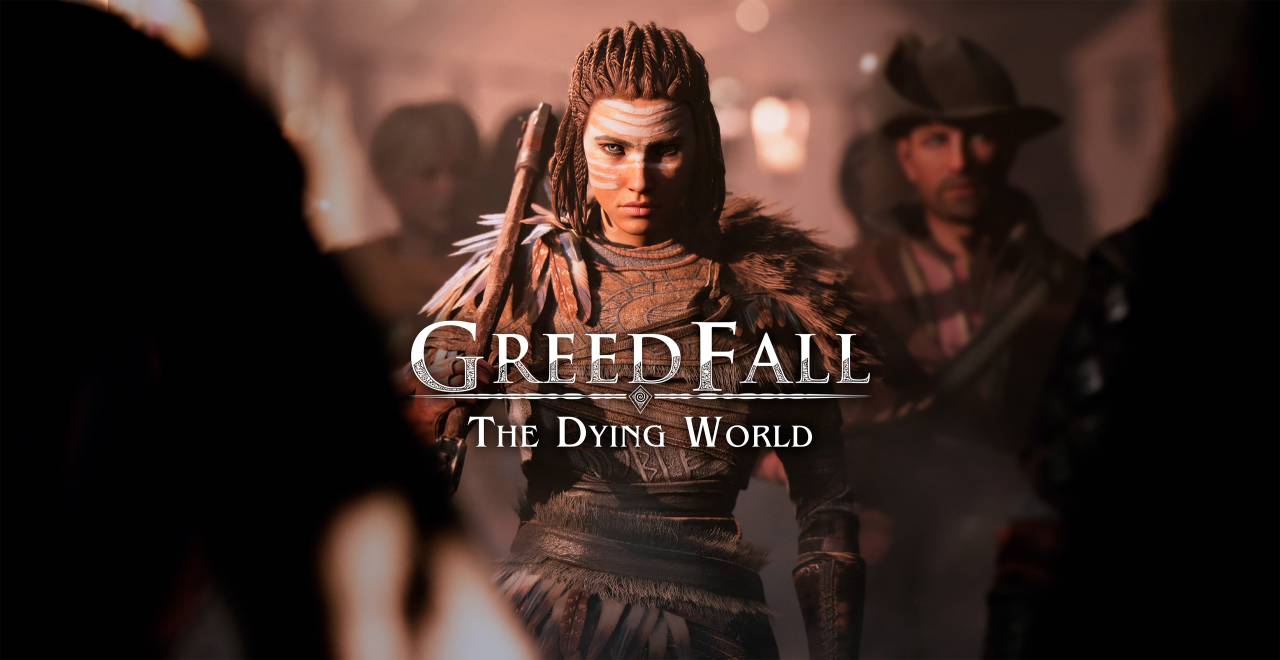
After a year and a half of player feedback, the follow-up to 2019’s GreedFall from French developer Spiders is finally launching out of Early Access alongside a full 1.0 release on consoles. Originally titled GreedFall 2: The Dying World, the game eventually dropped the number because it’s not a direct sequel. In fact, the events of The Dying World take place a few years before the first game. Which is good for players like me, as knowledge of the first game is not needed to keep up with the new one. I am about 10 hours into The Dying World at the time of writing this, and while I have a lot to say, it’s not enough to give the game a full score. So let’s consider this my in-depth first impressions of GreedFall and its 17th-century-inspired world.
The Dying World sort of flips the script of its predecessor. From my understanding, in GreedFall, you play as someone born on the continent of Gacane who travels to the new and mystical island of Teer Fradee in search of a cure for a rampant disease called the Malichor. In this game, you are a Teer Fradee native who, for reasons I won’t spoil entirely, is taken to the mainland. This comes with both good and bad side effects.
Unlike a typical RPG, The Dying World doesn’t waste time on a long, dramatic cutscene to set the stage. There are only a few quick sentences before you are asked to create your character, and a brief conversation after that, before you are free to roam. Teer Fradee is a beautiful backdrop to the prologue, and it’s a fun playground to get familiar with the game’s controls and mechanics. I won’t get into much of the story description here, but suffice to say, the game starts on an important day in the main character’s life. They are about to become a Sage, a respected role in the Teer Fradeen culture, and are given two tasks as initiation.
Even in the early hours, there are problems to be solved, choices to be made, and deals to be negotiated. In that way, the opening area feels like a mechanical microcosm of the full game you’re about to play. There’s a lot of effort put into building out the world of GreedFall, and the story is easily the most interesting thing about it. By reversing the roles of the protagonists, Spiders is able to use the fish out of water trope again from a different perspective. This isn’t a bold expedition onto a new frontier. It’s a push into the unknown. And narratively, I think that makes for a far more compelling protagonist.
The roadbump with this setup, however, is that it can be a bit overwhelming to get into the character’s headspace. You see, Spiders created a whole fictional language for Teer Fradeens to speak. And that’s what you’ll be hearing for the majority of the game’s prologue. (Which took me about seven hours to complete.) English is the language of foreigners, but seeing as it’s the only language I can understand without reading subtitles, it’s hard not to feel like an outsider yourself in a village where you are supposed to have lived your whole life. Thankfully, by the end of those early hours, the prologue gets you pretty familiar with the island and allows you to empathise with the Teer Fradeens perspective. And then, after a short cutscene and a great title card, you are thrust into a dying world.
The biggest change from GreedFall 1 to The Dying World is the combat. After the first game, there was an outcry from fans to make the gameplay a bit more dynamic and less repetitive. In response to that, Spiders created a new tactical real-time combat system with an active pause. This should look familiar to fans of Dragon Age: Origins or Knights of the Old Republic, as it means that, along with simply tapping the controls in real-time to perform attacks and actions, you can press R1 to pause the game, shuffle through each character and assign operations individually before letting it all resume. This is sort of a double-edged sword to talk about, because while I understand why it was implemented, I still find it rather unengaging.
When I said the combat should be familiar to fans of Dragon Age: Origins, that also refers to the repetitive animations and slow actions, which I didn’t like in that game either. The combat in The Dying World is slow, and while the use of tactics is helpful, it gets repetitive quickly. I restarted the game once I came to grips with the gameplay mechanics on my first run, so I could focus on the story. In that second playthrough, to mix things up from my usual stealth archer builds, I went with a lore-accurate mage for my main character, and I rarely find myself excited about repeated enemy encounters. This has more or less painted me into the corner of a stealth build because while I enjoy the game’s story, the gameplay became a hurdle for me to overcome. Consequently, I switch between the Adventure and Story mode difficulty to get through the combat sequences in my rerolled playthrough.
As party leader, you are responsible for managing the equipment, talents, skills, and attributes of your custom character and their companions. This isn’t too much of a task, as stats are pretty easy to read, and it’s not overly complicated. Attributes influence your character’s abilities, like Strength and Agility, while the skill tree is used for combat upgrades. To cap this off, Talents impact the success of your actions during gameplay. For example, stealth will increase the chances of a stealth roll succeeding, and diplomacy will give you higher chances at an effective negotiation. There’s a decent amount of flexibility here, and it allows you to create a character that best suits your interests.
This brings me to some of the rough edges I was referring to in the title. I came across several bugs in my 10 hours with the game. The first made it so my main character didn’t have a weapon equipped during an enemy encounter. He just stood there while everyone else fought. As someone who was trying to play centred around my own character (an option the game gives you with the “Focused” game profile), I was forced to either do nothing or switch to someone else and fight. Another happened a few hours later, when one of my weapons somehow got duplicated into both slots of my inventory. Meaning I couldn’t change to a better weapon and had to use the secondary.
Another less frustrating bug made it so my weapon was invisible, which meant that while I could deal damage, it looked like my character was playing pretend. The first issue I mentioned was fixed via a restart. As of now, the second is still unresolved, and I can’t use that original primary weapon. (I did eventually find a better one.) The third just sorted itself out. I want to make it clear that I am playing the PlayStation 5 version of the game for a week before the full release, but these kinds of bugs make it annoying to get through the already tiring combat, and while fast travel is appropriately fast, load times for reloading saves are not. I suppose hiccups are par for the course for ambitious RPGs from small European studios, but no matter how engaging the narrative, if the gameplay becomes something you have to slog through, it becomes harder and harder to continue.
Despite eighteen months in Early Access, it’s unfortunate to still feel the rough edges with GreedFall. For the time being, 10 hours in, The Dying World still has my interest thanks to an intriguing setup and solid voice acting. While I am not sure if that means I am through 1/3 of the game’s estimated 30-hour campaign, I am curious nonetheless as to where the narrative (and my hero) will end up. I hope Spiders patches the bugs because other than that and two crashes, the game has been otherwise fine. GreedFall looks good in its Graphics mode, and the soundtrack from Olivier Derivière is very good, maintaining a swashbuckling undertone amid its more sombre pieces. I have much more to say about the game, which I will save for my full review. Until then, GreedFall: The Dying World will launch worldwide on March 12 for PlayStation 5 and Xbox Series X|S. PC players and console Deluxe Edition owners can hop in two days earlier.
