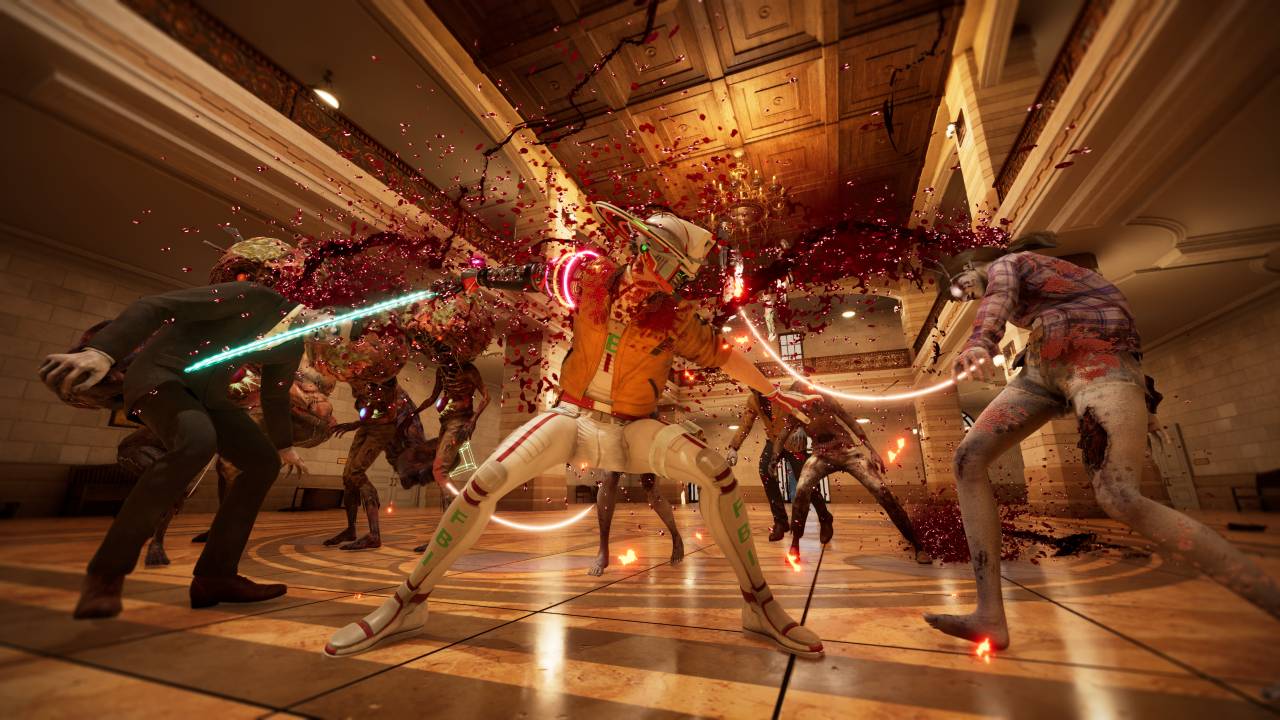
When it comes to crazy, hyper-violent action games with style spilling out of the seams, few studios come close to putting out the type of games that developer Grasshopper Manufacture concocts. Romeo is a Dead Man is the newest title from Grasshopper that offers up sci-fi time travel shenanigans, crunchy third-person combat mixing melee and shooting, growing your own rotting army of ‘Bastards’, and so many blood particles on screen that your framerate will take a dive. The game is undeniably a product of Grasshopper Manufacture and producer Suda51, in all the good and bad ways that come with that statement.
Players assume control over Romeo Stargazer, a police officer whose face is eaten by a white devil one night as he comes across a woman lying in the road. Before his untimely death, Romeo’s interdimensional time-traveling scientist grandfather, Benjamin Stargazer, appears to shove a device called the ‘Deadgear’ into Romeo’s skull, which proceeds to save his life… sort of. Romeo is transformed into a sort of hybrid human cyborg entity, a dead man who lives. Going by the name ‘Deadman’, Romeo is recruited into the FBI Space-Time Police, a branch of the FBI tasked with stopping space-time criminals across the fragmented universe, including his romantic flame Juliet.
I could go into more detail about the narrative in Romeo is a Dead Man, but I honestly see little point in doing so. The narrative is told at such a breakneck pace, visually changing styles of delivery from scene to scene in a way that feels deliberately hard to follow. In the opening 20 minutes alone, players are treated to a live-action opening of a miniature diorama of a town with voiceover from Romeo that transitions to a more traditional cutscene from a cop car dashcam point of view, only to once again transition to an animated comic book style presentation after a short gameplay tutorial. During gameplay, there will be sections where dialogue boxes appear on the side of the screen, offering conversations between Romeo and Benjamin that get obfuscated by the mayhem ensuing on screen. This style of delivering a narrative is certainly unique in its execution; however, due to how ungrounded this style of storytelling is, I found it very hard to follow what was actually going on in the broader picture.
That’s not to say I didn’t find it entertaining. As I mentioned, Romeo is a Dead Man is a Grasshopper game through and through, and if you have played any of their previous titles, this is pretty par for the course as far as the narrative goes. While over the top and a bit nonsensical, the writing has a certain flair to it that almost takes you aside and says, “don’t worry about it, just enjoy the ride”. Vocal performances are pretty good throughout as well. I particularly enjoyed Brittany Cox as Juliet and Larry Cedar as Benjamin. I felt they chewed up the material and really understood the assignment when it came to portraying their characters in this wild universe. While the narrative didn’t land for me on the whole, there are still plenty of philosophical musings about life and death that will send you down an existential thought path or a character moment that will give you a laugh.
As a fan of Grasshopper Manufacture, it’s the wacky visual presentation and the satisfying action that perk my ears up. While I mentioned it earlier as detracting from the narrative, the actual inclusion of the mixed media visual style is super interesting and gives Romeo is a Dead Man a distinct identity compared to many other games on the market. One of my favorite elements is the ‘Game Over’ screen, where an Indiana Jones-esque wax head of Romeo is melted as the text “Romeo is Dead” gets plastered on the screen, only for the footage to play back in reverse as you go to respawn.
Another great aspect of the visual design is the game’s hub area, the FBI Space-Time Police ship, The Last Night. This hub area is depicted as a top-down 2D pixel art environment that feels like it’s from another game or another time in game history to go with the time travel theme. Each member of the crew has their own part of the ship they call home. You can talk to characters through text boxes, and the music is delightfully retro and even dynamically changes to match the “vibe” of the room you are in. This stylistic flair characteristic of Grasshopper Manufacture is carried over to the user interface, which looks sleek, colorful, and clean.
If there is one noticeable and pretty big drawback of the presentation, it would be the game’s performance. Upon starting the game, it took me a solid hour of tinkering around with settings to get the game running pretty smoothly “most” of the time. Even after all the tinkering, there were specific moments of high-intensity action and particle effects going off that would cause the framerate to drop. Sprinting through certain areas of levels would cause the framerate to drop. For some reason, the game’s “subspace” level segments, which feature little combat, would also consistently run pretty poorly no matter which settings I tried to change. I played this game on PC, and while I don’t have a cutting-edge rig, what I do have should have been able to run the game with a decent framerate. I’m unsure of how the game performs on console, but just be aware that there’s definitely some slowdown to be expected with the PC version.
But enough of all that, you want to hear about the combat. Grasshopper’s action games all share a distinctive feel and satisfaction that stems from tight animations and stellar sound design, and Romeo is a Dead Man is a great addition to the lineup. To find a touchstone using previous works, the combat in Romeo is a Dead Man feels like a mix of No More Heroes and Lollipop Chainsaw when it comes to the feel of the melee combat, as well as the types of foes you slay. You unlock access to 4 different types of melee weapons that each have their own combos, attack speeds, and damage outputs that allow for experimentation and switching on the fly, which helps you cleave through the unending hordes of ‘Rotters’.
However, the addition of firearms gives Romeo is a Dead Man its own flavor and flow of combat. Like the melee weapons, you unlock 4 different ranged weapons: a pistol, shotgun, machine gun, and rocket launcher that can be swapped at the press of a button. Guns are normally holstered when moving around but a simple pull of the left trigger brings whichever gun you have equipped out and ready to unload. Enemies have a blue weak spot that, when shot, allows for a quick kill or a massive stagger state that allows you to close the distance and get a melee combo in to finish them off. Ammo for the guns is unlimited, so the only thing you need to be careful about is your positioning when having to reload, which is fairly slow.
Going in, I was cautiously curious how the balance between switching from melee to ranged combat was going to work, but those concerns were washed away once I started playing the game. Switching between the two modes of combat is seamless and natural, and once you get a few upgrades under your belt, the combat starts to come alive as you target an enemies weak spot with a quick rocket blast and immediately whip out your melee weapon to attack a ‘Rotter’ sneaking up behind you, everything exploding in a fountain of blood.
The cornerstone of the combat system is Romeo’s special finisher, Bloody Summer. As Romeo paints the walls red with Rotter gore, he collects this blood to fill the ‘Bloody Summer gauge’, and once this gauge is full you can unleash a powerful attack that deals a large chunk of damage and even restores part of your health. Each weapon has its own Bloody Summer attack, and you eventually unlock the ability to store multiple charges of the attack, which comes in handy for taking on some of the more tanky enemies and bosses. Pulling this bad boy out in a group of Rotters and watching them all decapitate in one fell swoop never got old and serves as the ultimate battle ender.
The sound design is the other side of the combat coin, and is similarly visceral and loud. You really feel each cut and gunshot, and when a Rotter’s head explodes, it gives almost the same sensation as a piñata exploding as candy rushes out. Even outside of combat, the clicks of letters appearing in a textbox, the whirring of The Last Night as it blasts through space, down to the ‘DEAD’ stinger that plays after clearing a combat arena, paint a vibrant soundscape that is pleasing to the ear, sort of like using one of those head massage devices… but for your ears.
Another big element of the combat to touch on is the game’s “Bastard” system. You see, killing Rotters occasionally results in them dropping an item called a ‘Bastard Seed’. These seeds can be brought to Romeo’s sister Luna on The Last Night, where she will identify what traits a given seed contains. These seeds can be planted, and after a short time, a full-grown rotten Bastard is ready to be plucked from the ground.
You can then equip these Bastards and call upon them and their unique traits in battle. There are loads of different traits you can choose from; some will put down a healing pool, some will pull the enemy’s attention away from Romeo, and some may just run forward and explode, damaging anything caught in its path. You eventually unlock the ability to equip multiple Bastards that synergize with others to create new gameplay opportunities. One synergy I grew fond of was that I had a Bastard that slowed time to a crawl in a specific area that I would drop on a group of enemies, and another Bastard would fire a bolt of chain lightning that would bounce between enemies. It was a great way of clearing through groups of enemies quickly. Once you use a Bastard, they go into a cooldown state, and once they recharge, Benjamin is calling out for you to “Send in the Bastards!” once more.
Bastard farming isn’t all sunshine and roses, however. You see, throughout the game, you pick up A LOT of Bastard Seeds, to the point where the game constantly reminds you to go back to the ship to sort them out. Planting the seeds starts out fun and quirky. You get this fun indicator as you pull the trigger, and Romeo pulls the Bastard from the ground, and you even get to select a name and personality trait for each of them. Unfortunately, it doesn’t take long for this process to become stale and monotonous. You have to pull every individual Bastard you plant with the same unchanging animations, and eventually, I started skipping through the process just so I could get what I needed and move on. The way you upgrade the Bastards is by fusing them together in this humorous cage match style setup, but this too feels overly drawn out to the point where I started skipping these as well. It’s a necessary part of the gameplay to be involved in, but it ultimately feels like a massive pace killer when you just want to get back to exploring and engaging in the satisfying combat.
As far as upgrades go, there are various ways to power up Romeo along his journey through time and space. Upgrade materials can be found through exploration, which can be used to upgrade the various weapons’ stats, like damage and how much blood they generate for the Bloody Summer Gauge. Killing enemies and exploring levels will reward you with a resource called ‘Emerald Flosion’, which is your primary currency and upgrade material. You can use Emerald Flosion to purchase consumable items on ‘The Last Night’, but I never felt this was all that necessary to engage with. The alternative use for Emerald Flosion is for upgrading Romeo’s stats, such as melee damage, weapon reload speed, the amount of healing items he can carry etc. Rather than upgrading these in a boring stat menu, you get to play a retro-style arcade game called ‘Deadgear Cannonball’. Here, Emerald Flosion is used as fuel to pilot a character around a maze to grab these little power-ups. Each of these power-ups upgrades Romeo’s different stats. You can reset your progress at any time to try and use a more efficient route through the maze or to try and collect different stat upgrades. This upgrade system was extremely fun and made me consider just how boring other games handle the simple act of leveling up.
There’s also a pin system in Romeo is a Dead Man that allows you to further customize and enhance Romeo’s abilities. You unlock pins through various means, and these pins have a range of different abilities. Some increase the damage dealt with specific weapons, some give you more resources when you defeat enemies, and some can even reduce the cooldown time of your Bastards. You are able to equip a few of these at one time, which can expand your specific playstyle in interesting ways.
All of these various factors of the combat system coalesce in the game’s boss fights. For Romeo is a Dead Man, the boss fights are a bit of a mixed bag. Many of Grasshopper’s games feature a “Rogues Gallery” type setup, a cast of villains that, like the main protagonists, are over the top and cartoonishly evil, which makes it all the more satisfying when you get to violently bring them to their end. The villain characters in Romeo is a Dead Man are far weaker than previous villains from other Grasshopper games, to the point where they are almost forgettable. In this game, most of the villains turn into giant, mutated freaks of nature, and these enemy designs are actually pretty awesome and grossly detailed. They have distinct silhouettes, unique attack patterns to learn, and can even put up a bit of a fight. A few of these bosses took me a couple of attempts to really learn and defeat, which was a good bit of fun, until the game resets you and replays all the preamble cutscenes that you need to skip through in order to properly retry the fight. So while the combat and learning the fights themselves are fun, there is some clunky implementation, and I wish the villain characters resonated with me more.
There is one area of the game that I feel is pretty underbaked, and that is in its level design. This is actually a gripe I hold towards many of Grasshopper’s games, that, for how insanely artistic, energetic, and stylish the presentations of these game worlds are, it’s that the levels themselves always feel boring by comparison. When I first learned that Romeo is a Dead Man was going to be a Sci-fi game, I got all excited thinking about the neat space visuals and cool concepts they could come up with for levels. But ultimately, the levels end up being pretty boring and lifeless versions of generic sorts of areas like a courthouse, a hospital, an overgrown forest, and so on. The art within the levels also doesn’t adequately convey that it is a place from a different point in time; most places just look like contemporary buildings.
Some levels are better than others, like the Deadford Mall, but even then, it’s still a mall. Some of these levels feature static props like cars or bikes that just kind of take up space, and some levels even float over an infinite ocean, which just kind of makes them look like they are temporary placeholder designs, not finished levels. I would really love to see this taken up a notch in future Grasshopper releases.
Despite the gripes I have with certain elements, the combat in Romeo is a Dead Man is actually the most fun I’ve had with a Grasshopper combat system in a while. By the time I hit credits, I had put about 20 hours into the game, and it was only in that last maybe two hours, after I had tried to thoroughly explore every level and complete every knock-off chalice dungeon, that I felt the game start to get a little repetitive. I feel certain games like No More Heroes 2: Desperate Struggle or Lollipop Chainsaw begin to set into a repetitive feeling fairly early on, so to get 20+ hours out of a game and still have the combat feel fun and engaging is definitely a win.
At the end of the day, I like Grasshopper Manufacture and their games, and I enjoyed Romeo is a Dead Man. It certainly has its flaws and its fair share of issues and confusing design decisions. But at the same time, it has an energy and a creative spirit that pushes past so many other games out now that feel overly designed by committees or chasing trends that inevitably have come to pass. Romeo is a Dead Man might be a hard game to recommend to someone new to the world of Grasshopper Manufacture or their style of game. But fans of their previous works and action games alike will find plenty to enjoy in this latest outing. Romeo is a Dead Man is available now on PlayStation 5, Xbox Series X|S, and PC via Steam.
